
Spray Polyurethane Foam Roof Systems in Tucson - Seamless Waterproofing for Thermal Cycle Stress
Spray polyurethane foam roof systems for Tucson commercial buildings - seamless monolithic application eliminates thermal-cycle seam stress in the Sonoran Desert, integrates insulation and waterproofing in a single system, and carries a silicone top coat for UV and monsoon protection.
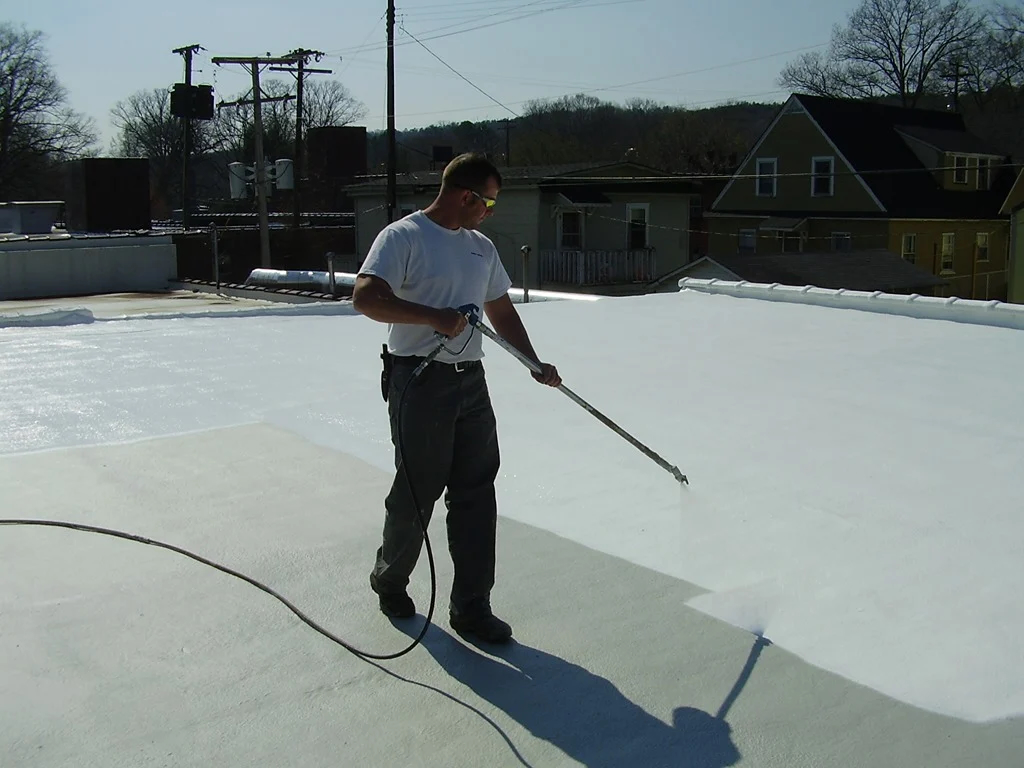
Spray polyurethane foam is the only commercial roof system that eliminates seams entirely - it is applied as a two-component liquid that expands in place, fills every penetration gap and surface irregularity, and cures into a monolithic foam substrate without field seams or laps. In Tucson's extreme thermal cycling environment, the absence of seams is a meaningful performance advantage.
Spray polyurethane foam (SPF) roofing consists of two components - isocyanate and polyol resin - that are mixed at the spray gun and applied as a liquid that expands into closed-cell foam within seconds of application. The foam adheres directly to the existing substrate, fills surface voids and around penetrations, and builds to the specified thickness in a continuous monolithic layer without the field seams, laps, T-joints, or termination bars that are the primary failure points on conventional membrane systems.
In Tucson's thermal environment, this is architecturally significant. Every seam and lap on a conventional membrane system is a point where differential thermal movement between adjacent membrane panels creates cyclic stress. Tucson's 30-to-70-degree daily temperature swings - common in spring, fall, and winter - cycle that stress hundreds of times per year over the system's service life. SPF roofing has no seams to stress. The monolithic foam substrate expands and contracts as a single unit without the seam-opening forces that accumulate in membrane systems over time.
SPF in Tucson is always coated - the foam substrate is UV-sensitive and will degrade rapidly without a protective top coat. The standard specification is a white silicone top coat applied to the manufacturer's minimum dry-film thickness over the cured foam. The silicone coat provides UV protection for the foam, delivers the white reflective surface required by Arizona IECC 2018, and resists ponding water without degrading. SPF plus silicone is an integrated system where each component depends on the other.
SPF Application and Substrate Requirements in Tucson
SPF can be applied over a wide range of existing commercial roof substrates in Tucson: existing TPO or PVC (where the substrate is sound and adhesion is verified), existing modified bitumen or BUR cap sheets (cleaned and primed), concrete decks, and metal decking. The foam adheres to the substrate and builds thickness in a single pass or multiple passes to reach the specified R-value. Penetrations are foamed in place - the foam expands around pipe boots, conduit penetrations, and curb edges, eliminating the lap and flashing assembly that is the failure point on conventional membrane penetration details.
The application window for SPF in Tucson is critical. The two-component foam is sensitive to moisture in the substrate and in the ambient air. In Tucson, ambient humidity is low for most of the year - a condition that favors SPF application. The exception is monsoon season, when morning humidity can be elevated from overnight moisture. We do not apply SPF to wet substrates or in high-humidity conditions - the moisture interferes with the isocyanate reaction and produces foam with compromised cell structure and adhesion. Pre-monsoon timing is ideal for SPF projects in Tucson; post-monsoon timing in October and November is also favorable.
SPF application generates overspray that must be contained to the building footprint. Adjacent properties, parked vehicles, and HVAC intake louvers must be protected during foam application. In Tucson's urban commercial areas - Downtown, the 4th Avenue corridor, midtown medical-office campuses - overspray protection is a critical pre-application setup item. We use temporary windscreens and stage application sequencing around wind conditions as part of every urban SPF project.
Thermal Performance of SPF in the Sonoran Desert
Closed-cell SPF has the highest R-value per inch of any commercial insulation material - approximately R-6.5 per inch at standard application density. A two-inch SPF application delivers approximately R-13, a four-inch application approximately R-26. Unlike polyiso board insulation, closed-cell SPF does not experience significant thermal drift at elevated temperatures - its R-value is more stable across the temperature range that Tucson rooftops experience than standard-density polyiso.
SPF's closed-cell structure is also an air barrier. In Tucson's commercial buildings, air infiltration through roof penetrations and at membrane terminations is a measurable energy-loss pathway - hot desert air entering the building envelope through roof assembly gaps drives HVAC load. SPF foam seals around every penetration and along every parapet as it is applied, effectively eliminating those infiltration pathways without a separate air-barrier component.
The slope-correction capability of SPF is valuable in Tucson's flat commercial roof context. Existing roofs with inadequate slope to drain - the most common cause of monsoon-season ponding on Tucson commercial roofs - can have slope corrected by varying the foam application thickness across the roof field. We can add tapered slope to a flat roof by applying thicker foam in the low areas and tapering to thinner foam toward drains, correcting the drainage geometry without expensive structural changes.
SPF Plus Silicone: The Complete System
The silicone top coat on an SPF roof is not optional in Tucson - UV exposure will degrade uncoated foam in weeks. The silicone coat is applied in a minimum thickness specified by the manufacturer to protect the foam for the full warranted period, typically 10 to 20 years depending on the coating specification. The white silicone surface delivers Arizona IECC 2018 solar reflectance compliance and provides the ponding-water resistance that Tucson's monsoon drainage conditions require.
Maintenance on an SPF-plus-silicone system focuses on the silicone coat. If the coat is damaged by impact - from rooftop equipment maintenance, hail, or debris - the foam below is exposed to UV and must be repaired promptly. We include a written post-storm inspection protocol in our maintenance contracts for SPF-roofed buildings in Tucson, with specific attention to any impact points following hail events and post-monsoon debris.
At the end of the silicone coat's warranted service life, the system can be recoated without removing the foam - the silicone coat is cleaned, primed where needed, and a new silicone top coat is applied. This recoating cycle can repeat multiple times over the life of the foam substrate, making SPF a long-term capital strategy for Tucson commercial buildings where the initial application is done correctly and the silicone coat is maintained.
Frequently asked questions
Why does the absence of seams matter on a Tucson commercial roof?
Seams and laps are the primary failure points on conventional membrane roofs. Tucson's thermal cycling - daily temperature swings of 30 to 70 degrees - stresses seam bonds hundreds of times per year. Over a system's service life, this cyclic stress progressively opens seam bonds, particularly at T-joints and flashing terminations. SPF eliminates all of these stress points by applying as a monolithic liquid that cures without seams. The result is a system where thermal cycling stresses the whole assembly evenly rather than concentrating at seam locations.
Can SPF be applied during Tucson's monsoon season?
No. SPF requires a dry substrate and low ambient humidity for the foam chemistry to work correctly. Monsoon season brings elevated morning humidity and the possibility of afternoon rainfall - conditions that are incompatible with SPF application. We schedule SPF projects in Tucson for late spring (April through June), early fall (October through November), or winter months when humidity is consistently low and the substrate can be verified dry.
How does SPF handle the slope correction needed on my flat Tucson commercial roof?
SPF's application thickness can be varied across the roof field - thicker foam in low areas, tapering to thinner foam toward drains - to create positive slope without structural changes to the roof deck. We conduct a drainage survey before the SPF specification to map existing low areas and calculate the taper geometry needed to achieve positive drainage to all drains. The slope correction is included in the application specification and documented in the project file.
What does an SPF roof system cost for a Tucson commercial building?
SPF-plus-silicone systems typically run in a similar range to premium single-ply systems - the foam-and-coating combination is not a discount approach. The value proposition is performance: no seams, integrated insulation-and-waterproofing, slope-correction capability, and long recoat cycles that defer future capital outlay. We produce a written cost comparison for SPF versus single-ply replacement for each building we assess as a foam candidate, so the decision is grounded in documented numbers specific to your building.
Evaluating SPF roofing for your Tucson commercial building?
Our project managers will assess the existing substrate, conduct a drainage survey, and produce a written SPF specification with slope-correction geometry, foam-thickness calculation, silicone top coat specification, and cost comparison against conventional single-ply alternatives.
Ready to talk through a roof?
Tell us about the building and the roof problem. We'll document it and put a plan in writing - with an honest repair-vs-replace recommendation and no upsell pressure.
Documented, repair-first commercial & industrial roofing across Tucson and Pima County. Flat and low-slope systems for occupied buildings, planned around your operation.
Services
© 2026 Commercial Roofing Contractors Tucson. All Rights Reserved. Privacy Policy · Terms of UseSite Map