
Built-Up Roof Systems in Tucson - Legacy BUR Assessment & Restoration
Built-up roofing assessment and restoration for Tucson commercial buildings - honest evaluation of aging BUR systems in the 105°F-plus Sonoran Desert environment, silicone restoration options, and replacement scope when the system is past candidacy.
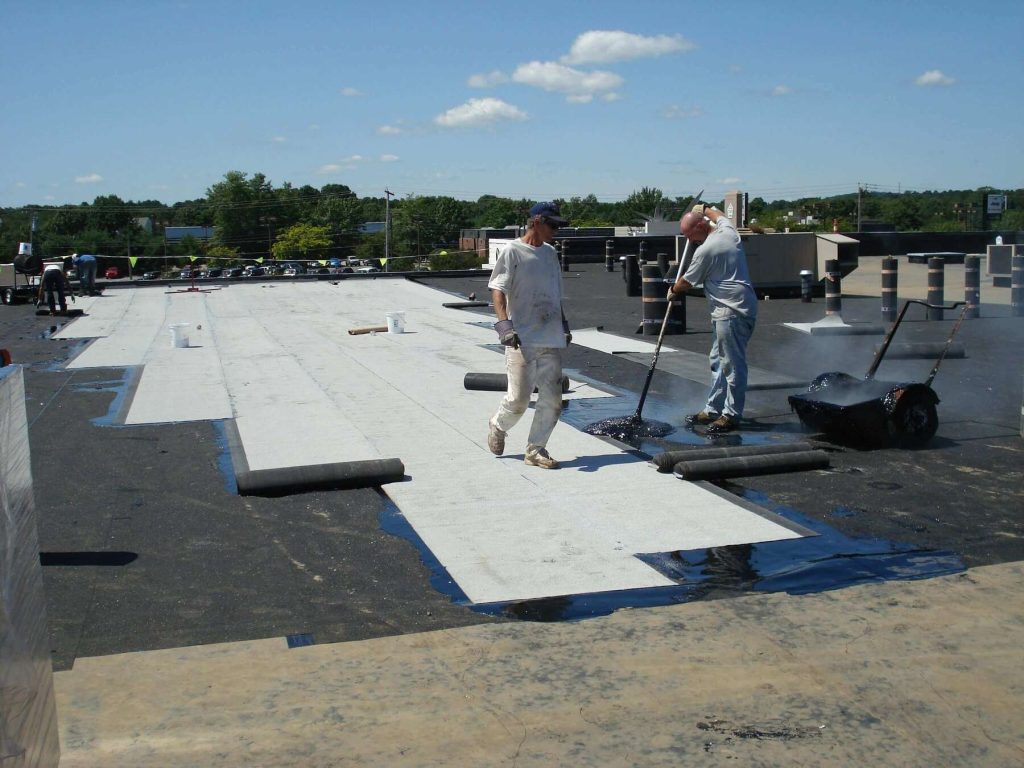
Built-up roofing was the commercial flat-roof standard for most of the twentieth century, and Tucson has a substantial inventory of BUR systems on downtown buildings, university facilities, and midtown commercial stock built from the 1950s through the 1980s. These systems are mostly past their original service life, and the question is whether the substrate supports restoration or requires replacement.
Built-up roofing (BUR) consists of multiple layers of bituminous plies - typically two to four - alternating with reinforcing felts and topped with a mineral-surfaced cap sheet, aggregate surfacing, or smooth-surface bitumen. It is a labor-intensive system by current standards, but BUR assemblies constructed properly have demonstrated 40 to 50-year service lives on some commercial buildings. Tucson's stock of BUR roofs represents some of the city's oldest commercial buildings - government facilities downtown, early University of Arizona construction, and midtown office and commercial blocks built before single-ply membranes were available.
New built-up roofing specification is rare in the Tucson commercial market today. The labor cost, the hot-kettle bitumen application (which introduces fumes and hot-work permit requirements), and the difficulty of meeting Arizona IECC 2018 reflectivity requirements with standard aggregate-surfaced or smooth-surface BUR all work against it as a new-system choice. Where we encounter BUR on new projects, it is almost always as the existing system being assessed for restoration or replacement.
The primary question on aging BUR in Tucson is moisture: built-up roofing can absorb significant amounts of water through surface checking, lap failures, and drain-area saturation while still appearing intact from the surface. Moisture in the insulation below a BUR assembly in Tucson's heat environment migrates and concentrates in patterns that surface inspection cannot reliably detect. Moisture cores and infrared scanning on clear evenings are the tools we use to determine what is actually in the insulation stack before writing a scope.
BUR Assessment in Tucson's Heat Environment
Tucson's 175°F-plus rooftop surface temperatures on dark BUR systems drive significant thermal cycling through the insulation stack below. BUR's aggregate or smooth-surface cap absorbs heat that white reflective systems reflect - the thermal load on the insulation, deck, and structural assembly is meaningfully higher than on a comparable building with a white membrane. Buildings with dark BUR and insulation approaching the end of its effective life may show R-value decline from both age and repeated high-temperature cycling.
Infrared scanning is our standard assessment tool for Tucson BUR roofs with uncertain moisture conditions. On a clear evening, the thermal differential between wet and dry insulation below the BUR assembly is detectable for six to eight hours after solar heating ends. We scan on cloud-free evenings - abundant in Tucson - and document wet areas by infrared image and GPS coordinates, then verify with physical core pulls at flagged locations. The scan-plus-core approach gives us reliable data on what is actually in the insulation stack.
Parapet flashing condition is the most common active failure point on aging Tucson BUR systems. The flashing stripping plies at parapet bases dry, crack, and separate under sustained UV exposure. Water entry at failed parapet flashings typically saturates the perimeter insulation before it is detected from interior ceiling indicators - the path from a failed parapet flashing to an interior stain is long and indirect in a BUR assembly. We inspect perimeter flashings separately from the field membrane on every BUR roof walk.
Silicone Restoration Over BUR in Tucson
Silicone coatings can be applied over sound built-up roofing systems in Tucson, and this is an increasingly common restoration strategy for BUR roofs with dry insulation and intact base structure. The silicone coating fills surface checking on the BUR cap, seals minor lap separations, restores a white reflective surface to energy-code compliance levels, and extends system service life 10 to 15 years. On buildings where the BUR insulation is dry and the structural assembly is sound, silicone restoration over BUR can deliver significant value relative to full tear-off and replacement.
The prerequisite is a clean, dry, primed surface. BUR with aggregate surfacing requires surface cleaning and, in some cases, removal of loose aggregate before coating application. The silicone primer bonds to the BUR bitumen surface and creates the adhesion base for the coating. We pull moisture cores and conduct an infrared scan before recommending any coating project on BUR - coating over wet insulation traps moisture, voids the coating warranty, and accelerates deck deterioration below the assembly.
For Tucson BUR roofs where silicone restoration is appropriate, the coating specification includes primer, base coat, and finish coat to the manufacturer's mil-thickness requirement, with reinforcement at all seams, laps, drains, and penetrations. The finished system is warranted by the coating manufacturer and documented with a roof-zone diagram and photo record at closeout.
Frequently asked questions
My 1970s Tucson commercial building has the original built-up roof. Is it worth assessing for coating, or should I plan for full replacement?
A fifty-plus-year-old BUR system is past its design service life, but that does not automatically mean it is saturated or structurally compromised. We have seen well-maintained BUR systems from this era with dry insulation that are solid coating candidates. The only way to know is moisture cores at representative locations across the roof and an infrared scan on a clear evening. We give you the core data and infrared results with a written coating-vs-replacement assessment before you make any capital commitment.
Can you do emergency repairs on a Tucson BUR roof during monsoon season?
Yes. Temporary dry-in on a failed BUR section during monsoon season is a common emergency call - a parapet flashing separation or surface failure that was dormant through the dry season becomes an active leak the first time monsoon rainfall hits the area. We respond to commercial BUR emergency calls across Tucson and can apply temporary bitumen repairs and membrane patches that hold through the monsoon while a permanent scope is developed.
Does a silicone coating over BUR comply with Arizona energy code?
White silicone coatings applied to the minimum specified dry-film thickness over BUR meet IECC 2018 Climate Zone 2 solar reflectance requirements. The coating manufacturer's published Solar Reflectance Index values are documented in the project closeout file. This is one of the reasons silicone restoration is an attractive option for dark-surface BUR systems in Tucson - it brings the assembly into energy-code compliance at the same time it restores the system.
Built-up roof on your Tucson building reaching end of life?
Our project managers will walk the roof, conduct an infrared scan on a clear evening, pull moisture cores at flagged locations, and produce a written assessment with a silicone-coating-vs-replacement recommendation grounded in condition data.
Ready to talk through a roof?
Tell us about the building and the roof problem. We'll document it and put a plan in writing - with an honest repair-vs-replace recommendation and no upsell pressure.
Documented, repair-first commercial & industrial roofing across Tucson and Pima County. Flat and low-slope systems for occupied buildings, planned around your operation.
Services
© 2026 Commercial Roofing Contractors Tucson. All Rights Reserved. Privacy Policy · Terms of UseSite Map