
Ballasted Roof Systems in Tucson - Why This System Is Not Recommended in the Sonoran Desert
Ballasted roof systems in Tucson - an honest assessment of why loose-ballast membrane systems are not recommended for new installation in the Sonoran Desert, the problems they create in monsoon conditions, and what to do with legacy ballasted EPDM on existing buildings.
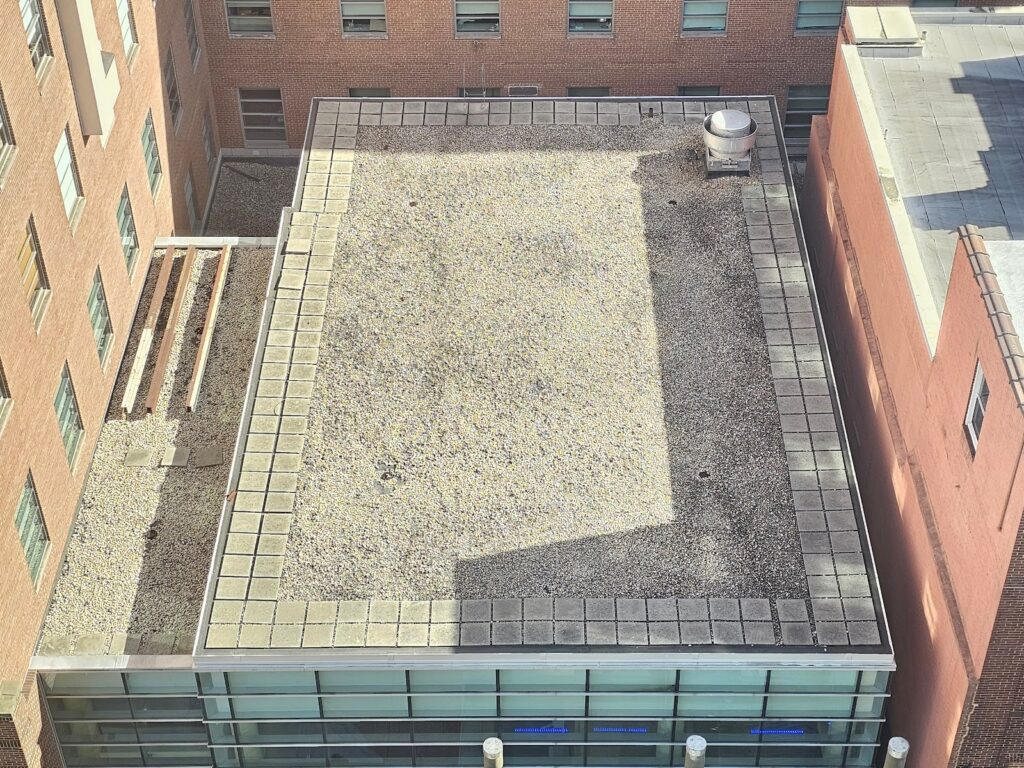
Ballasted roofing - loose-laid membrane weighted down by stone or pavers - is a legitimate commercial roof system in moderate-climate markets. In Tucson, it is not a system we recommend for new installation. Monsoon flash flooding, Sonoran Desert dust accumulation in ballast, energy code reflectivity compliance, and the structural load implications in a seismic region combine to make ballasted roofing a poor choice for new commercial construction in this market.
A ballasted roof system uses a loose-laid membrane - most commonly 60-mil EPDM - weighted to the deck by river-wash stone or concrete pavers rather than adhesive or mechanical fasteners. The ballast holds the membrane against wind uplift and protects the membrane surface from UV. The system is simple to install on large, open roof fields and historically economical where structural capacity for the ballast load exists.
In Tucson, the monsoon season fundamentally changes the performance calculation for ballasted roofing. Tucson's monsoon events deliver intense short-duration rainfall - the National Weather Service Tucson office records single-event totals exceeding two inches at Tucson International Airport, with higher totals in the mountain foothills. On a ballasted roof, that rainfall hits the stone ballast and must drain through the stone field to reach roof drains. In the process, the flowing water redistributes the ballast - stones move away from drain areas and accumulate at downslope locations, partially burying drains and creating uneven stone distribution that creates new low areas prone to future ponding.
Sonoran Desert dust accumulation in ballast is a secondary problem. After monsoon season, the stone ballast on a Tucson commercial roof accumulates mineral particulate from haboobs and windblown desert soils. Over years, this particulate fills the void space in the stone field, reduces drainage capacity through the ballast, and traps moisture against the membrane surface for extended periods after rainfall events. We inspect ballasted roofs throughout Tucson that have this problem - the stone field looks intact from the surface but has lost most of its drainage function.
Why We Do Not Recommend Ballasted Roofing for New Tucson Commercial Projects
The monsoon flash-flood risk is the primary concern. A ballasted EPDM roof in Tucson with partially blocked drains - a condition that develops within a few monsoon seasons even on well-maintained systems from stone migration and dust accumulation - can accumulate significant water depth on the roof during an intense monsoon event. The weight of standing water combined with the existing ballast load can approach or exceed the structural design load of some commercial buildings. We do not specify ballasted systems where that risk exists without explicit structural analysis of the ponding-plus-ballast load condition.
Arizona IECC 2018 energy code creates a second barrier to new ballasted installation. Black EPDM - the dominant ballasted membrane - does not White EPDM over ballast is available but uncommon, and the ballast itself covers most of the membrane surface, which complicates the reflectivity calculation. Getting a ballasted system to energy-code compliance in Tucson requires a non-standard specification path that adds cost and complexity without the performance advantages that TPO or PVC deliver at lower cost.
Seismic considerations matter in the Tucson market. Tucson is in a moderate seismic zone - USGS seismic hazard maps show meaningful ground-shaking potential in Pima County. Ballast adds 10 to 12 pounds per square foot of dead load to the roof structure. In older commercial buildings with concrete or masonry construction common in Tucson's midtown and downtown stock, additional dead load from ballast on a roof that was not originally designed for it can affect the seismic performance of the structure. We flag this as a structural engineering question for any owner considering ballasted installation on an existing building.
Managing Legacy Ballasted EPDM in Tucson
Tucson has a population of legacy ballasted EPDM systems from the late 1980s through the early 2000s on midtown and south-side commercial and industrial buildings. These systems were installed before the energy code reflectivity requirements and before the monsoon drainage problems with ballasted systems were well understood in the local market. Many are at or approaching end of life.
The standard replacement scope for aging ballasted EPDM in Tucson is ballast removal followed by installation of a white single-ply system - typically TPO or PVC mechanically attached. Ballast removal is a significant labor and disposal cost item that must be included in the project estimate: 10 to 12 pounds per square foot of stone must be lifted, loaded, hauled, and disposed of or recycled before the new system can be installed. A 30,000-square-foot ballasted roof carries approximately 150 to 180 tons of stone ballast. We include ballast removal sequencing and disposal logistics in every ballasted-roof replacement scope we write for Tucson.
For ballasted EPDM with dry insulation and an intact membrane, a ballast-over-recover approach - new membrane installed over the existing system with ballast reinstalled over the new membrane - is theoretically possible and saves the ballast removal cost. We assess this option when the existing insulation is dry and the structural system can carry the combined load. In practice, the monsoon drainage issues that caused problems with the original ballasted system will continue with a new one, and we typically recommend ballast removal and conversion to a mechanically attached system as the more durable long-term approach.
Ballast Inspection Protocol for Existing Tucson Buildings
Our inspection protocol for existing ballasted roofs in Tucson addresses the specific failure modes the Sonoran Desert creates. We assess stone distribution across the roof field for uneven accumulation, document drain bowl burial depth by ballast and debris, assess membrane condition at drain pans and parapet bases where stone has migrated away and left the membrane exposed, and probe-test membrane seams at accessible locations.
Infrared scanning on ballasted roofs in Tucson is complicated by the stone's thermal mass - the stone retains heat through the evening, reducing the thermal differential between wet and dry insulation that infrared imaging depends on. We schedule infrared scans on ballasted roofs for the latest feasible nighttime window - two to three hours after peak daily temperature - and supplement with physical core pulls at locations flagged by drain assessment and surface observation.
For occupied Tucson commercial buildings with legacy ballasted systems approaching end of life, we recommend a documented condition assessment with a replacement budget and timeline in the capital plan. Building owners who are refinancing, selling, or reporting to investors need a documented current roof condition - a 30-year-old ballasted EPDM system with no warranty, no documentation, and active monsoon-season drainage problems is a liability in any transaction.
Frequently asked questions
My Tucson industrial building has original ballasted EPDM from 1991. Is replacement urgent?
Not necessarily in an emergency sense - sound ballasted EPDM from that era can still hold water if the membrane is intact. But a 30-plus-year system with no warranty, no documentation, active monsoon drainage issues from stone migration and dust accumulation in the drain fields, and energy code non-compliance is a liability for capital planning, financing, and property transactions. We do a documented condition assessment with moisture cores and drain evaluation, then give you a written replacement timeline and budget range for capital planning purposes.
Can I add a coating over my existing ballasted EPDM to bring it into energy code compliance?
No practical option exists. Silicone and acrylic coatings require a clean, accessible membrane surface - ballast covers most of the membrane field and cannot be moved aside for coating application. The energy code compliance path for a ballasted EPDM building in Tucson is typically ballast removal and replacement with a white single-ply system. We include the ballast removal cost and disposal logistics in the replacement scope so the full project budget is transparent.
What does ballast removal and replacement cost on a Tucson commercial building?
Ballast removal adds to the project cost relative to a standard tearoff - labor to move and load the stone, trucking, and disposal or recycling of the material. A 30,000-square-foot ballasted roof carries roughly 150 to 180 tons of stone ballast. We include itemized ballast removal cost in every ballasted-system replacement estimate so the full budget is visible from the start. The conversion to a mechanically attached white single-ply system is the replacement scope - addressing the energy code compliance, eliminating the monsoon drainage problem, and documenting the new warranted system for the building's asset records.
Legacy ballasted roof on your Tucson commercial building?
Our project managers will inspect the existing ballasted system, assess drain condition and stone distribution, pull moisture cores, and produce a written condition assessment with a documented replacement timeline and budget range for your capital plan.
Ready to talk through a roof?
Tell us about the building and the roof problem. We'll document it and put a plan in writing - with an honest repair-vs-replace recommendation and no upsell pressure.
Documented, repair-first commercial & industrial roofing across Tucson and Pima County. Flat and low-slope systems for occupied buildings, planned around your operation.
Services
© 2026 Commercial Roofing Contractors Tucson. All Rights Reserved. Privacy Policy · Terms of UseSite Map