
PVC Roof Systems in Tucson - Chemical Resistance for Resort, Medical & Industrial Roofs
PVC single-ply roof systems for Tucson commercial buildings - chemical-resistant membrane for resort kitchen exhaust, medical facility HVAC, and industrial rooftop environments, with Arizona IECC 2018 reflectivity compliance.
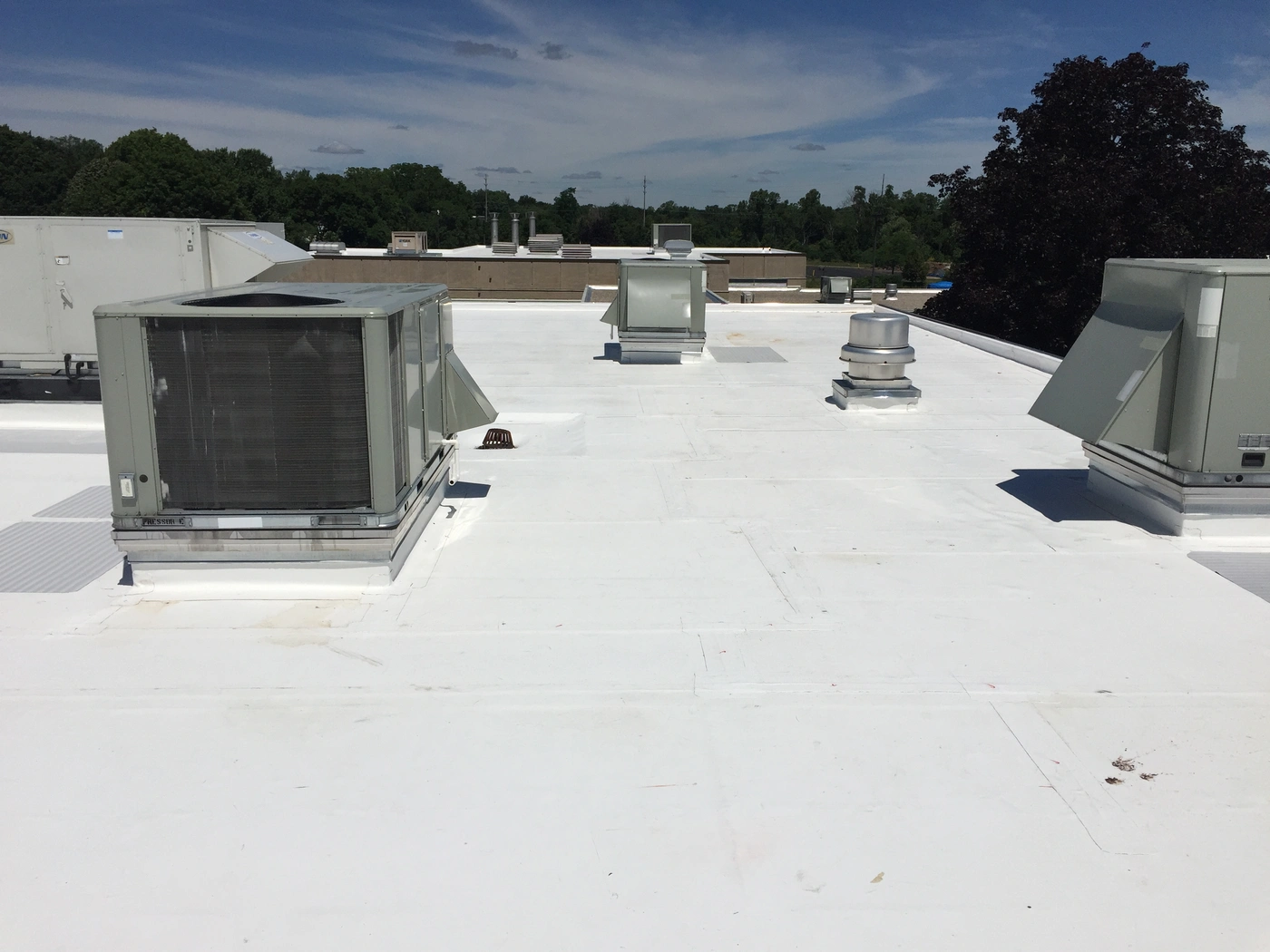
PVC membrane carries a specific advantage in the Tucson commercial market that white TPO does not: inherent resistance to fats, oils, and chemical vapors that degrade standard thermoplastic membranes. Resort hotel kitchens, medical center HVAC exhaust zones, and industrial facilities with process-chemical rooftop exposure are where PVC earns its premium over TPO.
PVC (polyvinyl chloride) and TPO are both white, heat-welded, single-ply thermoplastic membranes that meet Arizona's IECC 2018 solar reflectance requirements for new commercial roofs in Climate Zone 2. From an energy performance and reflectivity standpoint, they are broadly equivalent. The distinction that matters in Tucson's commercial market is chemical resistance.
PVC membrane resists fats, oils, greases, and many chemical vapors that TPO does not handle as well over time. Tucson's resort hotel and hospitality corridor - Starr Pass, Ventana Canyon, the Westward Look, properties along East Skyline Drive - operates large-volume commercial kitchens with rooftop exhaust systems that discharge cooking vapors and grease-laden air against the membrane surface. Standard TPO in those exhaust zones can degrade measurably within five years. PVC holds up.
The same logic applies at Banner University Medical Center Tucson, TMC HealthCare, and the medical-office campuses along Campbell Avenue and North Wilmot Road: HVAC exhaust streams from sterilization equipment, pharmaceutical storage, and laboratory ventilation contain chemical compounds that affect TPO membranes differently than PVC. We specify the right membrane for the rooftop environment, and on buildings with complex exhaust chemistry, that membrane is frequently PVC.
Where PVC Is Specified in Tucson's Commercial Market
Tucson's hospitality sector is a significant commercial roofing segment. The resort properties in the Foothills - Loews Ventana Canyon, Hacienda del Sol, Arizona Inn, and the conference properties along East Sunrise Drive - have large commercial kitchen operations with rooftop exhaust that discharges against the membrane surface. Maintaining a white, reflective, warranted membrane in that environment requires PVC's chemical resistance. We assess exhaust discharge locations during the pre-construction roof walk and specify PVC in those zones or across the full membrane field depending on exhaust coverage.
Healthcare facilities in Tucson represent a second primary PVC application. Banner University Medical Center Tucson on Campbell Avenue, TMC HealthCare on Rincon, St. Joseph's Hospital on North Wilmot, and the growing medical-office corridor in the midtown market all have rooftop mechanical systems with exhaust chemistry that warrants PVC specification. Hospital rooftop environments also frequently include pharmaceutical refrigeration units, sterilization exhaust ports, and compressed-gas handling - each a potential source of membrane-degrading vapor exposure.
Industrial tenants in the Tucson market with solvent-handling or chemical-process operations - manufacturing facilities on the south side near the Tucson International Airport industrial corridor, laboratory buildings at UA Tech Park, and defense-sector facilities near Davis-Monthan AFB - may have rooftop environments where PVC's broader chemical resistance spectrum is the right specification. We document the rooftop chemical environment in the pre-construction assessment for all industrial projects.
PVC in Tucson's Sonoran Desert Heat Environment
PVC and TPO behave similarly under Tucson's UV and heat loading - both are white reflective membranes that meet IECC 2018 requirements, and both form heat-welded seams that hold up under thermal cycling. There are some nuances: PVC membranes have historically been more sensitive to extreme cold temperatures, which in Tucson is rarely an issue given that winter nights rarely drop below 20°F even in the Catalina Foothills submarket. Conversely, PVC's heat-weld window at the seam welder is somewhat more temperature-sensitive than TPO - in Tucson's summer ambient conditions, seam welding on large PVC fields should be sequenced into morning hours to keep the membrane and substrate temperatures in the weld equipment's calibrated operating range.
PVC membranes can stiffen at lower temperatures and become more susceptible to cracking if subjected to impact during cold Tucson winter mornings. In practice, the window when Tucson temperatures are cold enough to affect PVC membrane behavior is narrow - December through February morning hours in the Foothills. We schedule PVC seam work around ambient temperature when the project runs into that window.
The insulation specification under PVC in Tucson is the same as TPO: high-density polyiso or a polyiso-plus-cover-board stack to account for thermal drift at the 175°F-plus surface temperatures this market produces. Standard-density polyiso underperforms its labeled R-value under Tucson operating conditions regardless of what membrane sits on top.
PVC Warranty and Manufacturer Credentials in Tucson
PVC manufacturers with active warranty support in the Tucson market include Sika Sarnafil, Carlisle, and GAF. NDL warranty paths require the same conditions as TPO: credentialed applicator, adherence to manufacturer detail drawings at every flashing and penetration, manufacturer field rep closeout inspection, and documented annual maintenance. We prepare the closeout documentation - including the chemical-exposure assessment that supports the PVC specification - as part of the warranty package.
For resort and healthcare buildings in Tucson, the closeout package includes a membrane-zone diagram that identifies each exhaust discharge location relative to the membrane field, documents the PVC specification rationale, and provides the manufacturer's published guidance on exhaust-exposed membrane maintenance. This documentation matters when the building changes ownership or facility management - the next manager needs to understand what is on the roof and why.
Frequently asked questions
My Tucson resort property has commercial kitchen exhaust hitting the roof membrane. What should we use?
PVC is the standard specification for membrane zones exposed to kitchen exhaust vapors and grease-laden air. Standard TPO degrades in that environment over a multi-year horizon - the chemical exposure breaks down the membrane's plasticizer over time. During the pre-construction roof walk we document every exhaust discharge location and assess how the prevailing wind patterns distribute exhaust across the membrane field. In some cases the exposure is concentrated enough that only the affected zones need PVC; in others the full membrane field is PVC.
Is PVC more expensive than TPO, and does it warrant the premium?
PVC typically runs $0.30 to $0.60 per square foot more than TPO at equivalent thickness and attachment method. For most standard Tucson commercial buildings without specific chemical exposure, white TPO is the more cost-effective choice. For resort, medical, and industrial buildings with rooftop chemical environments, the premium is warranted by the difference in membrane service life in those conditions - a TPO membrane degraded by five years of kitchen exhaust exposure costs more to replace than the PVC premium on the front end.
Does PVC comply with Arizona energy code for new commercial roofs?
Yes. White PVC meets IECC 2018 Climate Zone 2 solar reflectance requirements at standard specification - the same as white TPO. We document the membrane's Solar Reflectance Index value in the permit package and the warranty closeout for the building owner's energy-compliance records.
Resort, medical, or industrial building in Tucson? Let us assess the rooftop environment.
Our project managers will walk the roof, document exhaust discharge locations and chemical exposure conditions, and produce a written membrane specification with a PVC-vs-TPO analysis grounded in the actual rooftop environment of your building.
Ready to talk through a roof?
Tell us about the building and the roof problem. We'll document it and put a plan in writing - with an honest repair-vs-replace recommendation and no upsell pressure.
Documented, repair-first commercial & industrial roofing across Tucson and Pima County. Flat and low-slope systems for occupied buildings, planned around your operation.
Services
© 2026 Commercial Roofing Contractors Tucson. All Rights Reserved. Privacy Policy · Terms of UseSite Map