
TPO Roof Systems in Tucson - Reflective Single-Ply for Sonoran Desert Heat
TPO single-ply roof systems for Tucson commercial buildings - white reflective membranes that meet Arizona IECC 2018 Climate Zone 2 energy code, rated insulation stacks for 175°F rooftop surface conditions, and manufacturer-warranty closeout.
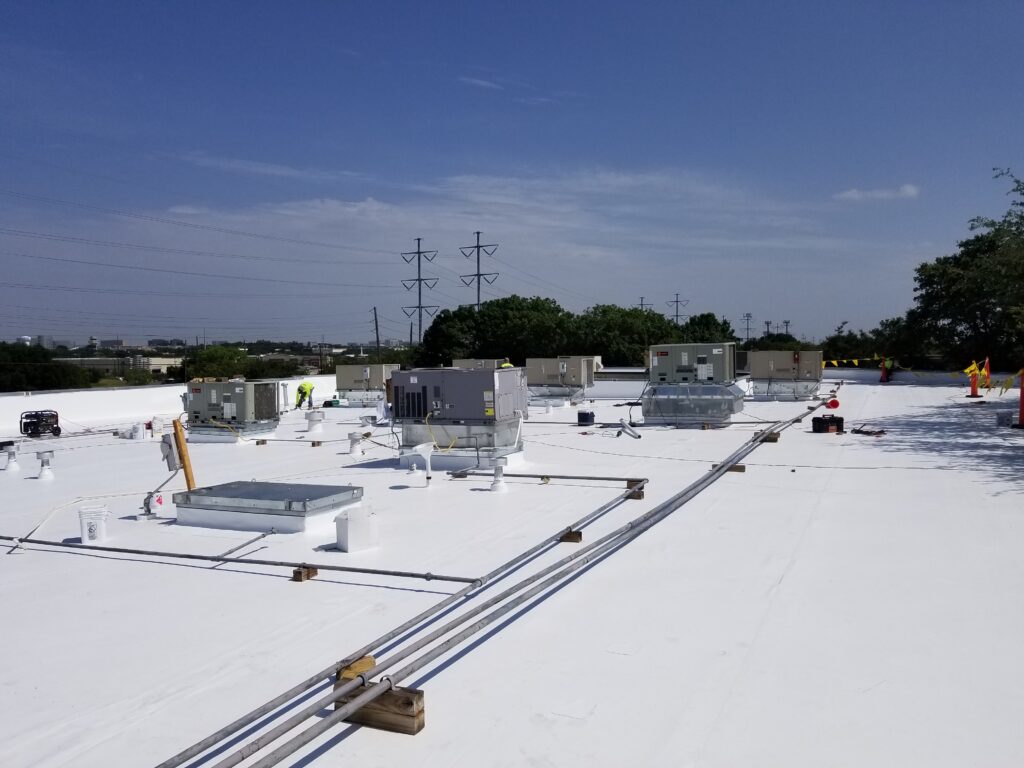
In the Sonoran Desert, white TPO is not a preference - it is an engineering response to rooftop surface temperatures that regularly exceed 175°F on dark membranes. Reflectivity reduces that surface temperature by 50 to 70 degrees, protects the insulation stack below, and satisfies Arizona energy code in a single membrane specification.
TPO is the dominant commercial roof membrane in Tucson and across the Sonoran Desert for a specific reason: white or light-gray TPO reflects solar radiation that would otherwise drive rooftop surface temperatures to levels that shorten membrane life and increase HVAC loads in the buildings below. Tucson sits in ASHRAE Climate Zone 2B - hot-dry - with ambient summer temperatures routinely above 105°F and UV Index values in the extreme classification (11-plus) for five months of the year. Membrane color is not an aesthetic choice in this market; it is the primary lifecycle and energy-compliance variable.
Arizona's energy code - IECC 2018 with Arizona amendments - mandates minimum solar reflectance values for new commercial roofs in Climate Zone 2. TPO's white membrane meets those values at standard specification, without the added cost of a reflective coating over a dark base membrane. Every TPO scope we write documents the membrane's Solar Reflectance Index value in the closeout file so the building owner has the compliance record for permits and insurance.
Tucson's monsoon season introduces a second performance demand. A roof that has been thermally cycled all summer - seams contracting and expanding through 30 to 40-degree daily temperature swings - faces its greatest water-infiltration challenge when the first intense monsoon convective cell arrives in July. TPO's heat-welded seams create a monolithic waterproofing layer that holds up to that combination of thermal fatigue and sudden water loading better than lap-adhesive systems. We specify seam width and weld parameters against the manufacturer's published detail drawings on every project, because that is what the warranty inspector reviews at closeout.
How Sonoran Desert Heat Changes TPO Specification
Standard-density polyiso insulation loses effective R-value at elevated temperatures - the industry calls this thermal drift. At 175°F rooftop surface temperature, the effective insulating value of a standard polyiso board is materially below its labeled rating at 75°F. In a market like Tucson where rooftop surfaces spend months in that temperature range, a standard polyiso stack underperforms its permit-submitted energy compliance calculation throughout most of the year. We specify high-density polyiso boards or a polyiso-plus-cover-board stack on every Tucson TPO project to maintain actual thermal performance under operating conditions.
Parapet flashings receive some of the highest UV doses on any Tucson commercial roof. They are vertical surfaces that intercept direct radiation from low-angle morning and afternoon sun that horizontal membrane surfaces partially deflect. UV degradation at parapet terminations is the most common source of early warranty claims on Tucson commercial roofs - the field membrane may be intact while the flashing has failed at the termination bar. Our standard detail extends the TPO membrane up the parapet face and over the cap with termination bar and peel-stop sealed to the manufacturer's specification.
Monsoon dry-in protocol runs from July 1 through September 30: no open roof sections overnight. During TPO installs in monsoon season, we size daily tear-off sections to what the crew can membrane-over and seam-closed the same day. Monsoon convective cells can initiate with 20 to 30 minutes of warning over the Santa Catalinas - National Weather Service Tucson Flash Flood Watches can activate within 30 minutes of storm formation. A Tucson commercial building with an open roof section on a July afternoon faces real interior water-damage risk. Our monsoon sequencing protocol is in writing and provided to the owner before contract execution.
Mechanically Attached vs Fully Adhered in Tucson Conditions
Mechanically attached TPO is the standard installation method for most Tucson commercial work. The membrane and insulation are fastened to the deck through a pattern of screws and plates calculated against the building's wind-uplift requirement under IBC 2021. Tucson's prevailing winds are moderate, but buildings in open commercial corridors - the Airport area, Irvington Road industrial, the Rita Road UA Tech Park corridor - can see higher design uplift values that require tighter fastener patterns. We calculate fastener density against the specific building's Exposure Category, not against a generic metropolitan default.
Fully adhered TPO bonds the membrane to the cover board with TPO-compatible bonding adhesive. We specify fully adhered systems on buildings where deck conditions limit additional fastener penetrations, on architecturally sensitive structures in Downtown Tucson and the 4th Avenue corridor, and on reroofs where wind-uplift requirements exceed what a mechanical pattern can deliver at reasonable fastener density. Fully adhered systems have a temperature window for installation - bonding adhesive does not perform properly above 95°F ambient, which in Tucson means fully adhered work on large footprints should be sequenced into morning hours during summer months.
Manufacturer Warranty Paths for Tucson TPO
A 20-year no-dollar-limit (NDL) manufacturer warranty means the manufacturer pays to repair a qualifying leak during the warranty period regardless of labor or material cost - it is not a prorated material-only document. Qualifying for NDL on a Tucson commercial project requires: installation by a manufacturer-credentialed applicator, adherence to the manufacturer's published detail drawings at every flashing condition and penetration, a manufacturer's field representative inspection at closeout, and documented annual maintenance for the warranty period.
we install major TPO manufacturers including Carlisle SynTec, GAF EverGuard, Johns Manville, and Sika Sarnafil. We do not have a preferred manufacturer - specification depends on warranty terms, the building's specific requirements, insulation stack compatibility, and available field rep support in the Tucson market. The NDL warranty document is delivered at project closeout, along with the roof zone diagram, photo record, and energy-compliance summary.
Frequently asked questions
Why is white TPO required for Tucson commercial buildings and not just recommended?
Arizona has adopted IECC 2018 with state amendments that mandate minimum solar reflectance values for new commercial roofs in Climate Zone 2, which covers Tucson. White TPO meets those values at standard specification. Beyond code compliance, white membrane reduces rooftop surface temperature by 50 to 70 degrees compared to dark membranes in the Sonoran Desert environment - a difference that meaningfully extends membrane and seam life and reduces cooling load in the buildings below. Dark TPO is available but does not
How does Tucson's monsoon season affect a TPO installation schedule?
From July 1 through September 30 we apply a monsoon dry-in protocol: we size daily tear-off sections to what the crew can membrane-over and seam-closed the same day. No open sections remain overnight during monsoon season. For large-footprint buildings, this extends the overall installation schedule - a 60,000 square foot building that might take four weeks in April may take six weeks in August. Owners receive a written monsoon sequencing plan before contract execution so the schedule is documented, not verbal.
Can you assess whether a silicone coating over the existing TPO is a better capital decision than replacement?
Yes. Every aging Tucson commercial roof gets moisture cores pulled before we write a replacement scope. If the core data shows the insulation is dry and the membrane is intact, a silicone coating system applied over the existing TPO is often the right call - typically one-third the cost of tear-off and replacement, with 10 to 15 years of additional service life when properly specified. If the cores show saturation, coating over wet insulation traps moisture and voids the coating warranty. We give you the core data and the written scope recommendation so the decision is based on condition data, not assumptions.
Are you licensed to pull permits for TPO roof replacement in Tucson?
Arizona requires commercial roofing contractors to hold an active Registrar of Contractors (ROC) license. We carry ROC licensure along with general liability, workers' compensation, and umbrella coverage at limits appropriate for the commercial projects we take on. We prepare the IECC energy compliance documentation - reflectivity values, R-value calculation, insulation specification - and manage the permit submittal with City of Tucson Development Services or Pima County, depending on the building's jurisdiction.
Scope a TPO roof system for your Tucson building.
Our project managers will walk the roof, pull moisture cores if the coating-vs-replacement question is open, and produce a written TPO scope with manufacturer warranty path, insulation specification, energy-compliance documentation, and monsoon-season sequencing plan.
Ready to talk through a roof?
Tell us about the building and the roof problem. We'll document it and put a plan in writing - with an honest repair-vs-replace recommendation and no upsell pressure.
Documented, repair-first commercial & industrial roofing across Tucson and Pima County. Flat and low-slope systems for occupied buildings, planned around your operation.
Services
© 2026 Commercial Roofing Contractors Tucson. All Rights Reserved. Privacy Policy · Terms of UseSite Map