
EPDM Roof Systems in Tucson - Heat Absorption Trade-Offs Explained Honestly
EPDM single-ply roof systems for Tucson commercial buildings - we explain the heat-absorption trade-off honestly, when EPDM is still the right specification, and when white TPO or silicone restoration is the better Sonoran Desert choice.
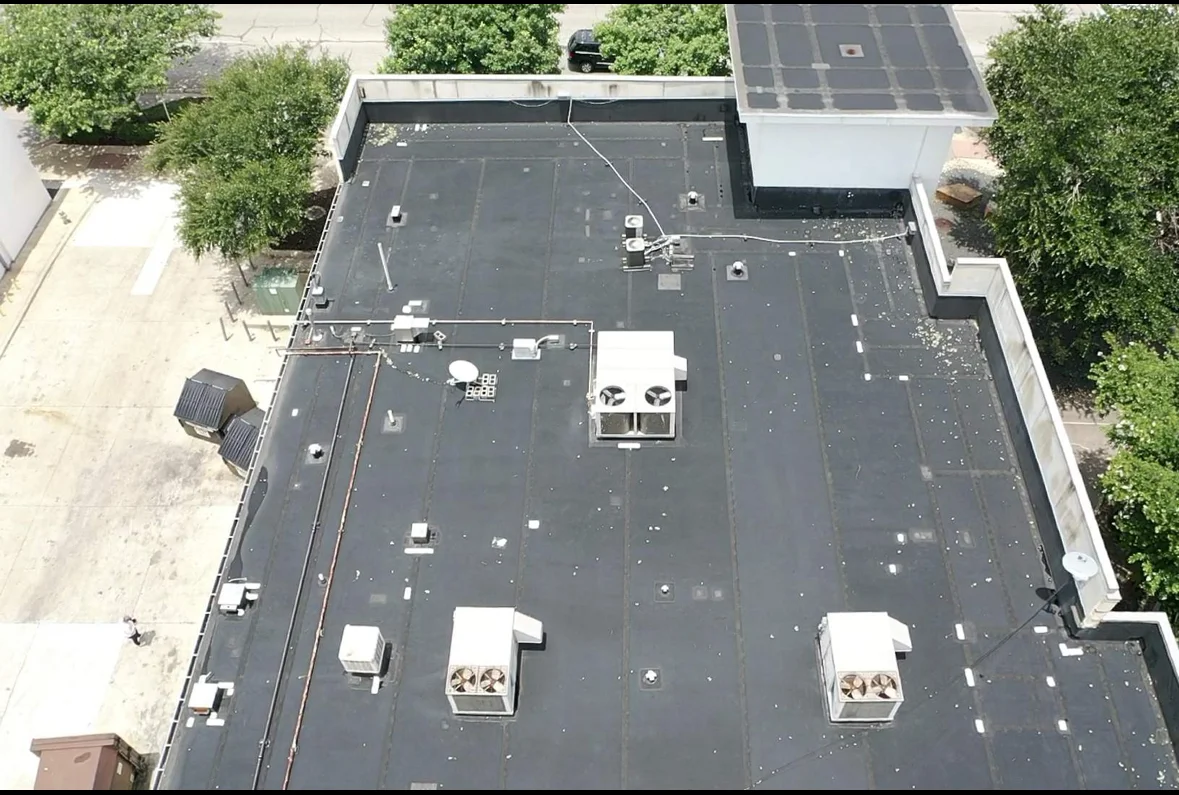
EPDM has a long and legitimate track record as a commercial roofing membrane. In Tucson, it also carries a real trade-off that deserves an honest discussion: black EPDM absorbs heat aggressively, driving rooftop surface temperatures to levels that increase HVAC loads and may not We explain where EPDM makes sense and where the Sonoran Desert climate makes another system the better call.
EPDM (ethylene propylene diene monomer) is a vulcanized rubber membrane with a 40-plus year performance record on commercial roofs across North America. Its elongation properties handle thermal cycling well, its rubber composition resists many chemical exposures, and older fully adhered EPDM systems on Tucson buildings from the 1990s still hold water today. The membrane's durability credentials are real.
The honest trade-off in Tucson is surface temperature. Black EPDM absorbs solar radiation rather than reflecting it. On a Tucson commercial roof in July, a black EPDM surface can reach 185°F to 195°F - 10 to 20 degrees hotter than dark TPO and 60 to 80 degrees hotter than white reflective membranes. That heat drives up cooling loads in the building below, accelerates adhesive and seam-tape degradation faster than manufacturers' temperate-climate service-life estimates, and in most cases does not meet Arizona's IECC 2018 minimum solar reflectance requirements for new commercial roofs in Climate Zone 2.
White EPDM is available, and fleece-backed EPDM systems with field-applied white coatings exist. We discuss these options when a project has specific reasons to prefer EPDM - existing chemical exposure conditions, substrate compatibility with an adhered system, or a building owner working from an existing spec. What we do not do is install black EPDM on a Tucson commercial building without documenting the energy-code compliance question and the heat-absorption trade-off in the project record.
When EPDM Is Still the Right Specification in Tucson
EPDM's outstanding elongation - the membrane can stretch up to 300 percent before failure - makes it well suited to buildings with substrate movement that would stress less elastic membranes. Industrial buildings with heavy equipment vibration, older buildings with flexible or uneven decks, and structures where significant thermal cycling of the deck assembly is expected can benefit from EPDM's ability to accommodate differential movement without seam failure.
EPDM outperforms TPO and PVC in resistance to petroleum-based chemical exposure. Industrial facilities with rooftop HVAC units that exhaust oils or vapors, restaurant buildings with kitchen exhaust systems, and manufacturing facilities with process-chemical environments can see their roof membrane exposed to substances that degrade standard TPO over time. EPDM's synthetic rubber composition handles most of these exposures better. We assess the rooftop chemical environment before specifying membrane type on any industrial Tucson project.
For Tucson buildings where EPDM is the appropriate specification, we address the heat-absorption issue through system design: white EPDM where the manufacturer offers it, a fluid-applied white coating over black EPDM at final close-out, or a recover strategy that brings the assembly into energy-code compliance. We document the solution in the permit package and the warranty closeout.
End-of-Life EPDM Replacement in Tucson
Tucson has a population of fully adhered EPDM commercial roofs from the late 1980s through the early 2000s that are at or approaching end of serviceable life. These systems - primarily on midtown office buildings along Broadway and Speedway, early UA Tech Park facilities on Rita Road, and older industrial properties on the south side - frequently show oxidized membrane with hairline surface cracking, failed seam tapes, and parapet flashings that have separated from the termination bar. They are holding water, but barely.
Replacing an aging fully adhered EPDM system requires pulling the membrane and assessing the insulation for saturation. The adhesive bond on fully adhered EPDM makes removal more labor-intensive than a mechanically attached tearoff. We include removal sequencing and disposal in every EPDM replacement scope - landfill costs in Pima County for EPDM membrane and insulation are factored into the project estimate.
When we replace aging EPDM in Tucson, the replacement system is almost always white TPO or white PVC - the energy code, the rooftop heat environment, and the warranty support structure all favor the reflective single-ply options for the new system. We will recommend EPDM as the replacement membrane when there is a specific technical reason to do so, and we will document that reason in the project record.
EPDM vs TPO for Tucson - Honest Comparison
Both membranes are legitimate commercial roofing systems. In the Sonoran Desert climate, the comparison comes down to four variables: energy code compliance, heat management, seam technology, and total cost of ownership. White TPO meets IECC 2018 reflectance requirements at standard specification; black EPDM does not. White TPO reduces rooftop surface temperature by 50 to 70 degrees versus black EPDM in Tucson conditions - a difference that shows up in annual energy bills. TPO's heat-welded seams are generally considered more consistent than EPDM tape seaming in field conditions. Cost of ownership over a 20-year horizon in Tucson typically favors white TPO.
Where EPDM holds an advantage: elongation for substrate movement, chemical resistance for industrial exhaust environments, and in some configurations, better low-temperature performance on Tucson's winter nights when temperatures drop below 30°F in the Foothills and Catalina Foothills submarket. We give owners a documented comparison for their specific building so the membrane decision is based on the building's actual conditions, not a product-agnostic default.
Frequently asked questions
Does black EPDM comply with Arizona energy code on new commercial roofs in Tucson?
In most cases, no. Arizona has adopted IECC 2018 with amendments mandating minimum solar reflectance for new commercial roofs in Climate Zone 2. Black EPDM's solar reflectance is typically in the 0.06 to 0.09 range - well below the code threshold of 0.55 for low-slope roofs. White EPDM and EPDM systems with a field-applied white coating can For most Tucson commercial buildings, white TPO or white PVC is the simpler path to energy-code compliance.
I have original 1990s fully adhered EPDM on my midtown Tucson building. What are my options?
First, a moisture-core assessment to determine whether the insulation below the membrane has accumulated saturation. If the cores are dry and the membrane surface is intact without significant cracking, a fluid-applied silicone coating over the EPDM may extend service life 10 to 12 years at roughly one-third the cost of full replacement - and restore surface reflectance to energy-code levels. If the cores show saturation or the membrane is beyond coating candidacy, the right scope is tear-off and replacement with a white single-ply system. We give you the core data and a written recommendation before you make any capital commitment.
Is EPDM ever the right choice for a new commercial roof in Tucson today?
Yes, in specific circumstances: industrial buildings with petroleum-based chemical exposure on the rooftop, buildings where substrate movement requires maximum membrane elongation, and projects where an existing specification or tenant requirement calls for EPDM and white EPDM or a coated system can address the energy-code compliance question. We do not install black EPDM on Tucson commercial roofs without documenting the energy-code compliance approach and the heat-absorption trade-off in the project record.
EPDM system on your Tucson building - need an honest assessment?
Our project managers will walk the roof, pull moisture cores, and produce a written condition assessment with a coating-vs-replacement recommendation that accounts for the Sonoran Desert heat environment, Arizona energy code, and the specific conditions of your building.
Ready to talk through a roof?
Tell us about the building and the roof problem. We'll document it and put a plan in writing - with an honest repair-vs-replace recommendation and no upsell pressure.
Documented, repair-first commercial & industrial roofing across Tucson and Pima County. Flat and low-slope systems for occupied buildings, planned around your operation.
Services
© 2026 Commercial Roofing Contractors Tucson. All Rights Reserved. Privacy Policy · Terms of UseSite Map