
Industrial Flex Space Roofing in Tucson, AZ
Low-slope roofing for multi-tenant industrial flex buildings in Tucson, AZ. We map every tenant penetration, coordinate bay-by-bay, and spec membranes built for the Aviation and Butterfield corridors.
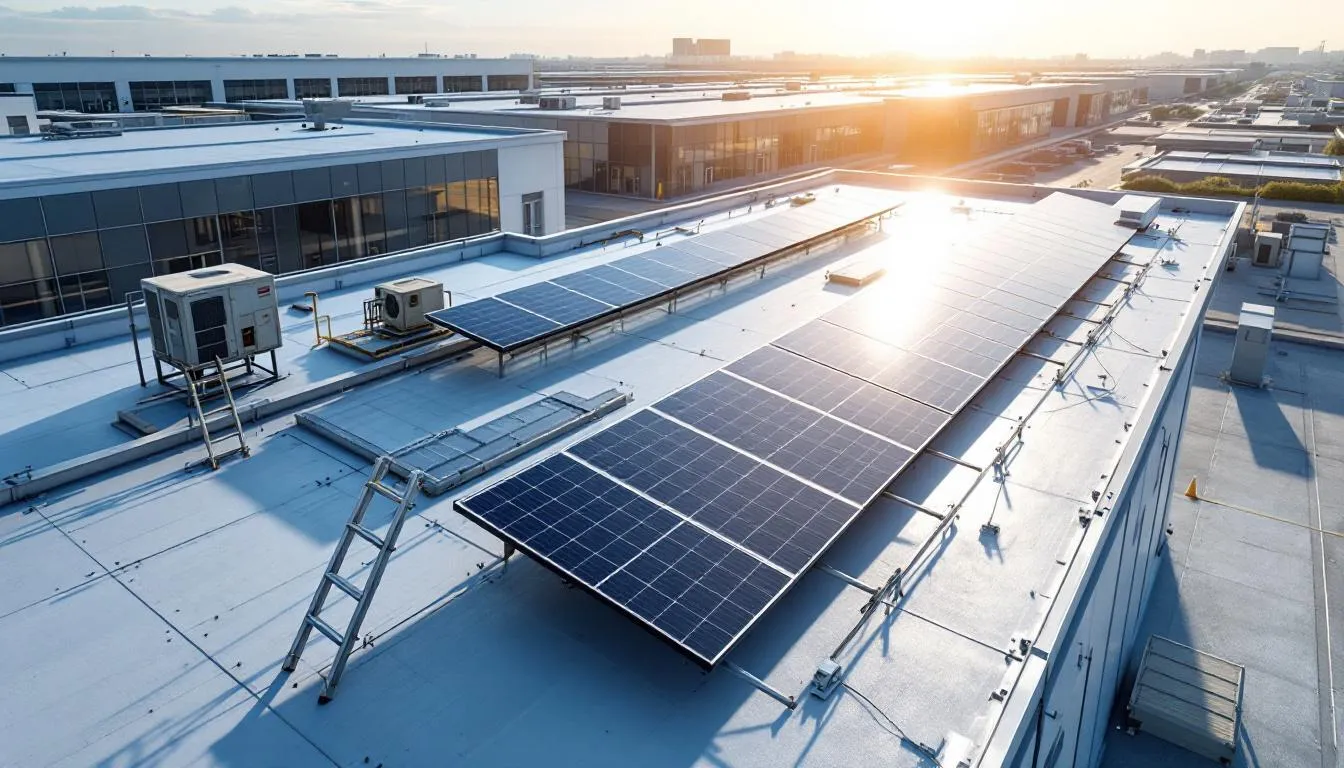
A flex building is the hardest roof in the Tucson industrial inventory to scope sight-unseen, because the building you bid is rarely the building you find on the deck. One bay runs a machine shop, the next a logistics 3PL, the third a startup's prototype lab with its own server closet, and the roof above all three has absorbed a decade of tenant improvements that nobody wrote down. We start every flex roof in this city the same way: a penetration-by-penetration walk before a single price goes on paper.
Most of the flex product we work on sits along the Aviation Corridor and the Butterfield Business Park near the airport, the Price Service Center area off Palo Verde, and the I-10 frontage between Valencia and Irvington where tilt-wall shells from the 1980s share parking with newer pre-engineered metal buildings. The Port of Tucson intermodal yard on the southeast side keeps pulling distribution and light-assembly tenants into this submarket, and that churn is exactly what shapes the roofing problem. Buildings designed for one anchor tenant now carry four, and the roof loading plan never caught up.
Why multi-tenant flex roofs fail differently
A single-occupant warehouse roof ages in a predictable way. A multi-tenant flex roof ages wherever the lease activity happens. Every time a bay turns over, somebody adds a packaged rooftop unit, runs a new gas line or condensate drain, cores the deck for a data or power chase, or drops an exhaust fan over a paint booth. Each of those is a hole in the membrane, and on the flex buildings we inspect the penetration density is routinely two to three times what the original construction documents show.
The failures cluster at those add-ons. Reused pitch pans dry out and crack. Field-fabricated curbs sit too low to flash to warranty height. Abandoned penetrations from a vacated tenant get capped with mastic that lasts one monsoon. We treat the penetration inventory as the real scope of a flex project - the field membrane is almost the easy part.
What we put down, and why
The Tucson sun is the governing load on a low-slope flex roof. UV and surface temperatures that run well past 160 degrees on a black roof in July degrade an unprotected membrane fast, so reflective single-ply is the default here. For tilt-wall and concrete-deck flex shells, our standard specification is 60-mil reflective TPO mechanically attached over tapered polyiso, which corrects the drainage flats that older flex roofs always carry and meets the cool-roof intent of the local energy code.
- Buildings with dense rooftop equipment or constant HVAC-service foot traffic get bumped to 80-mil TPO or a fully adhered 60-mil PVC for puncture and grease resistance, especially over bays with food-adjacent or shop tenants.
- Pre-engineered metal flex buildings are evaluated for a silicone-coated metal restoration or a retrofit standing-seam recover before we default to tear-off, since purlin spacing and panel condition often allow us to save the deck.
- Walkway pad is run from every roof hatch and ladder to each serviced unit, because the next decade of tenant HVAC contractors will walk that roof whether we plan for them or not.
Working around live bays
Coordination is the deliverable that separates a clean flex project from a tenant-complaint disaster. Before we mobilize we get a bay-by-bay occupancy map and a lease-contact list from property management, mark which units have active rooftop equipment, flag the vacant bays, and note any tenant with noise or HVAC-downtime sensitivity. Communication runs through the property manager, not directly to each tenant, so messaging stays controlled.
Work is sequenced bay by bay with written daily dry-in. We do not leave a section open over a tenant's space at the end of a shift, and we confirm watertightness before the crew rolls off. On occupied flex roofs, that discipline is the whole job.
Lease transitions and vacant-bay risk
The riskiest moment in a flex roof's life is a bay turnover. When a tenant pulls their rooftop units on the way out, the curb openings get covered with temporary protection that almost never survives the first heavy rain, and a vacant bay collects blow-in debris far faster than an occupied one, which chokes drains and starts ponding. Any roof inspection we run for a Tucson flex property in transition confirms curb-cap status, verifies that the departing tenant's penetrations are properly sealed, and clears the drainage path before the bay sits empty through a monsoon season.
Industrial Flex Space Roofing Questions
How do you handle undocumented tenant penetrations?
We photograph and map every penetration on the roof, compare it against original drawings where they exist, and flag any non-standard or improperly sealed detail for remediation before new membrane goes down. That survey is what prevents warranty fights after closeout, because on a flex building the as-built almost never matches reality.
What membrane is right for a multi-tenant flex building?
Reflective 60-mil TPO mechanically attached over tapered polyiso is the cost-effective default for tilt-wall and concrete shells in Tucson. Buildings with heavy equipment density or multiple tenants' service crews on the roof justify 80-mil TPO or fully adhered 60-mil PVC for the added puncture and traffic resistance.
How do you coordinate tenants on different leases and schedules?
It starts with an occupancy map and contacts from property management. We identify active rooftop equipment, vacant bays, and noise-sensitive tenants, then sequence the work and confirm daily dry-in through the property manager so tenants get notice without crews fielding direct calls on the roof.
How is a flex roofing project priced?
Pricing is per roof square based on membrane spec, deck and assembly condition, penetration density, and bay configuration, set after a roof walk and core sample where needed. Portfolio owners get standardized condition reports across their flex holdings so capital planning lines up building to building.
Do you work on standing-seam metal flex buildings?
Yes. Pre-engineered metal buildings get evaluated for a coated-metal restoration or retrofit standing-seam recover against full replacement, based on panel condition, purlin spacing, and load capacity. We install both approaches across Tucson.
Ready to talk through a roof?
Tell us about the building and the roof problem. We'll document it and put a plan in writing - with an honest repair-vs-replace recommendation and no upsell pressure.
Documented, repair-first commercial & industrial roofing across Tucson and Pima County. Flat and low-slope systems for occupied buildings, planned around your operation.
Services
© 2026 Commercial Roofing Contractors Tucson. All Rights Reserved. Privacy Policy · Terms of UseSite Map