
Weather watch · Prepare your roof
Prepare for flood watch conditions in Sahuarita
The National Weather Service has issued a flood watch covering Sahuarita. Heavy rain and drainage loading can expose roof leaks, blocked drains, and ponding water. This is a weather exposure advisory; it does not establish damage to a specific roof.
Review your leak-response contacts and existing roof concerns. Arrange drainage checks only when safe. Follow official local weather guidance.
National Weather Service · Updated Sep 27, 2026, 4:17 AM UTC
Commercial Roofers in Sahuarita, AZ
Commercial roofers serving Sahuarita, AZ should document leak sources, wet insulation, drainage, edge details, penetrations, and repair history before recommending a scope. Commercial roof inspections, replacements, and maintenance for Sahuarita's Walmart distribution complex, Rancho Sahuarita retail and professional corridor, and the Rio Rico industrial and logistics buildout south of Tucson.
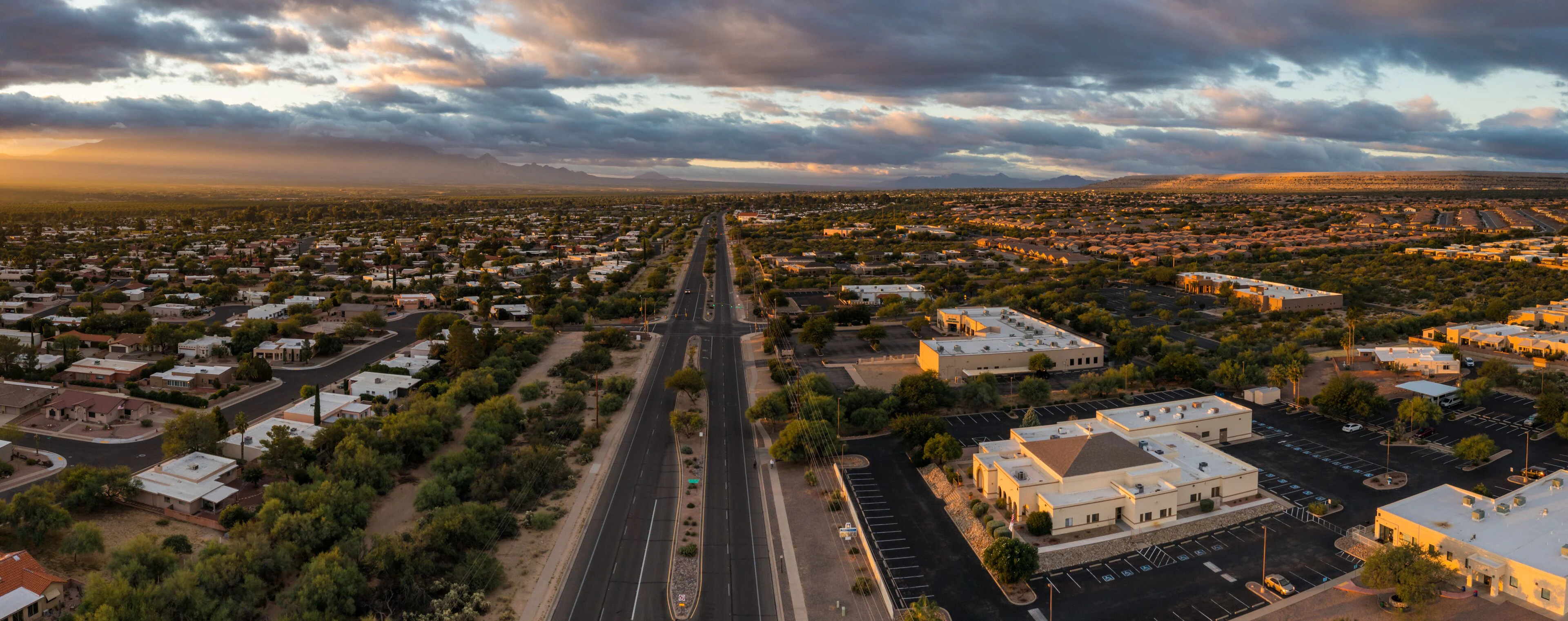
Sahuarita's commercial base is split between the Rancho Sahuarita community retail corridor along Sahuarita Road and a growing industrial and logistics cluster centered on the Walmart distribution center - two distinct building inventories with different roofing cycles and maintenance requirements.
Sahuarita sits roughly 15 miles south of downtown Tucson at an elevation of approximately 2,800 feet, in the broad agricultural valley between the Santa Cruz River and the Santa Rita Mountains. The town grew rapidly in the 2000s and 2010s as the Rancho Sahuarita master-planned community attracted significant residential population, and the commercial infrastructure that followed - retail centers, medical-office buildings, restaurants, and professional services along Sahuarita Road - is now entering the 15 to 20 year range on its original roofing systems. At the same time, Sahuarita and the adjacent Rio Rico corridor have attracted logistics and industrial investment driven by proximity to I-19 and the Nogales border crossing.
The Santa Rita Mountains directly to the east of Sahuarita create orographic uplift that intensifies monsoon rainfall events in this submarket. Sahuarita regularly records higher monsoon storm totals than downtown Tucson - convective cells that form over the Santa Ritas can produce several inches of rainfall in short windows, driving significant runoff toward lower-lying commercial properties along Sahuarita Road. We document roof drain capacity and condition for Sahuarita commercial buildings with particular attention to overflow drain sizing, which must handle peak monsoon flows that are higher here than at lower-elevation Tucson sites.
Sahuarita Commercial Roof Inventory
Rancho Sahuarita retail and professional corridor (Sahuarita Road from La Canada Drive to Camino de Manana): The primary commercial spine of the Rancho Sahuarita community, developed 2002 through 2018. Grocery-anchored centers, medical-office buildings, banks, restaurants, and service retail on single-story and two-story flat-roof construction. Roofing systems in this corridor range from 8 to 22 years old - the earliest Rancho Sahuarita retail buildings are in active replacement cycles, while the newer 2015 and later construction is in first-maintenance mode.
Walmart distribution center and logistics campus (Commerce Drive, east of I-19): One of the larger distribution facilities in southern Arizona, the Walmart complex anchors the industrial and logistics land use in the Sahuarita/Nogales Highway corridor. Large distribution center roofs of this type - 500,000 to over one million square feet - require zone-by-zone inspection methodology, tapered insulation documentation, and multiple-drain-system assessment. Work scheduling must account for 24-hour logistics operations and dock-access constraints.
I-19 corridor industrial and logistics (Sahuarita Road interchange and south toward Rio Rico): Light industrial, warehousing, and distribution facilities along the I- interchange. Buildings in this corridor range from 2005 through 2022 construction. The proximity to the Nogales border crossing makes this corridor active for cross-border logistics operations with scheduling constraints that require pre-construction coordination.
La Canada Drive professional and medical-office cluster: Professional services, dental and medical offices, and financial services buildings at the intersection of La Canada Drive and Sahuarita Road. These smaller-footprint buildings (typically 3,000 to 25,000 square feet) are in the 10 to 18 year range and are the primary candidates for restore-vs-replace assessment in the current market cycle.
Elevation, Monsoon, and Santa Rita Mountain Effects
Sahuarita's 2,800-foot elevation gives it a marginally cooler summer ambient temperature than the lower-elevation Tucson basin, but the UV Index at this elevation is correspondingly higher - approximately 5 to 8 percent above the value for the same latitude at sea level. The combination of elevated UV exposure and the Santa Rita Mountain orographic effect makes Sahuarita commercial roofs operate in a more demanding environment than the elevation difference from downtown Tucson would suggest.
Monsoon season at Sahuarita is among the more intense in Pima County. The National Weather Service Tucson area forecast office regularly issues Flash Flood Watches that include the Santa Rita Mountain foothills, covering the eastern portions of Sahuarita's commercial area. Commercial buildings with rooftop drainage systems that rely on gravity scuppers discharging to grade need those scuppers sized and maintained for peak Santa Rita monsoon flows. We assess overflow drain and scupper capacity as a specific line item on every Sahuarita roof inspection.
Sahuarita's agricultural valley location means the area is subject to strong outflow winds from monsoon cells - haboob events that originate over the Avra Valley or the Tohono O'odham Nation lands to the west can push significant dust loads across the Sahuarita commercial corridor with little warning. Rooftop HVAC equipment on buildings we maintain gets pre-monsoon filter documentation as part of our June inspection - that is outside roofing scope but it flags a condition that building operators often miss until the first monsoon event deposits significant particulate in air handling systems.
Sahuarita and Pima County Permit Process
Commercial roofing work in incorporated Sahuarita requires permits from the Town of Sahuarita Building Safety Department. For commercial projects, the Town typically processes building permits in 5 to 10 business days. IECC 2018 energy compliance documentation is required at submittal - reflectivity and R-value calculations must be submitted with the permit application and reviewed before issuance.
The industrial and logistics corridor along I-19 and south toward Rio Rico includes both incorporated Sahuarita parcels and unincorporated Santa Cruz County parcels. Jurisdiction determination is a required first step before permit application for any project in this corridor - address data alone does not reliably indicate whether a parcel is within Sahuarita municipal jurisdiction, unincorporated Pima County, or Santa Cruz County. We verify jurisdiction at the pre-construction phase of every project south of the Sahuarita Road interchange.
For large distribution and logistics facilities, we engage property management and operations staff in a pre-construction meeting before permit submittal to document work windows, dock-access restrictions, and any operational constraints that will affect tear-off sequencing. Projects of this scale in Sahuarita's logistics corridor require written sequencing plans that are approved by facility management before crew mobilization.
Frequently asked questions
How far is Sahuarita from your Tucson office?
Sahuarita is approximately 20 to 25 minutes south of downtown Tucson on I-19. We run regular inspection routes through the Rancho Sahuarita corridor and the I-19 industrial area. Emergency dry-in response for Sahuarita commercial buildings is same-day for calls received before noon.
Can you handle large distribution center roofs in the Sahuarita logistics corridor?
Yes. Large-footprint distribution facilities require zone-by-zone inspection methodology, multiple-drain-system documentation, and sequenced tear-off plans that account for 24-hour logistics operations. We scope projects of this type with facility management and document work windows and dock-access restrictions in a written pre-construction plan before crew mobilization.
Do Sahuarita commercial buildings need the same reflective membranes as Tucson?
Yes. Sahuarita falls within ASHRAE Climate Zone 2B, and Arizona's IECC 2018 requirements for solar reflectance apply. At Sahuarita's elevation, UV exposure is marginally higher than central Tucson - white TPO and PVC are the standard specifications for the same energy-compliance and membrane-longevity reasons that apply across the Tucson metro.
What is the permit process for roofing work in Sahuarita?
Incorporated Sahuarita projects require permits from the Town of Sahuarita Building Safety Department - typically 5 to 10 business days for straightforward commercial replacement. Projects in the I- may fall under unincorporated Pima County or Santa Cruz County jurisdiction, which we verify before any permit submittal.
Need a Sahuarita commercial roof inspection or scope?
Our project managers cover the Rancho Sahuarita corridor and the I-19 logistics area on regular south-Tucson routes. We will walk your roof, document the condition, and produce a written report for capital planning, pre-monsoon preparedness, or post-storm documentation.
Ready to talk through a roof?
Tell us about the building and the roof problem. We'll document it and put a plan in writing - with an honest repair-vs-replace recommendation and no upsell pressure.
Documented, repair-first commercial & industrial roofing across Tucson and Pima County. Flat and low-slope systems for occupied buildings, planned around your operation.
Services
© 2026 Commercial Roofing Contractors Tucson. All Rights Reserved. Privacy Policy · Terms of UseSite Map