
Modified Bitumen Roof Systems in Tucson - Honest Assessment for a Hot-Climate Market
Modified bitumen roof systems for Tucson commercial buildings - we explain where mod-bit still makes sense, where it falls short in the 105°F-plus Sonoran Desert environment, and what the alternatives look like.
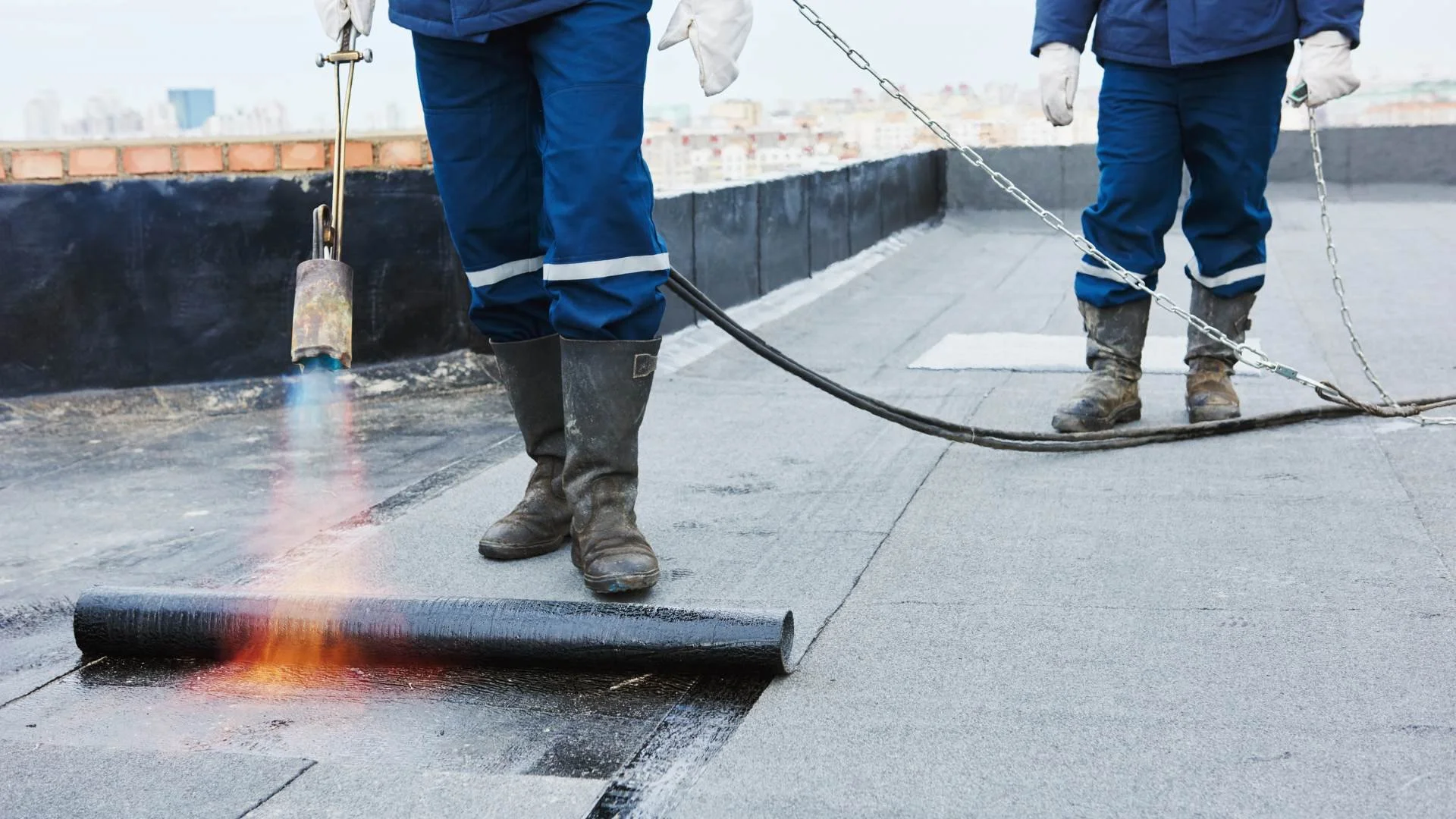
Modified bitumen was a standard commercial roof specification through the 1990s and into the 2000s. In Tucson, the system faces a specific challenge that drives its current market position: at 105°F ambient temperatures and 175°F-plus rooftop surface temperatures, bitumen chemistry behaves differently than it does in more temperate markets. We install and restore mod-bit systems, and we tell you when something else is the better answer.
Modified bitumen roofing uses asphalt modified with polymer compounds - styrene-butadiene-styrene (SBS) or atactic polypropylene (APP) - to improve flexibility, elongation, and UV resistance over standard built-up bitumen. SBS-modified systems use torching or cold-adhesive application; APP-modified systems are typically torch-applied. Both have a legitimate track record on commercial roofs across the country.
In Tucson's extreme heat environment, the specification calculus is more complicated. APP-modified bitumen, which is torch-applied, behaves well in high-ambient-temperature environments because APP is a thermoplastic modifier - the membrane becomes more workable, not less, at elevated temperatures. SBS-modified systems, particularly in smooth-surface or granule-surface configurations, can soften and experience plasticizer migration at sustained 175°F-plus rooftop temperatures. The granules on a granulated SBS cap sheet are there partly for UV protection and partly for dimensional stability - in Tucson, granule embedment and surface condition should be inspected annually.
The harder question in Tucson is energy code compliance. Smooth-surface or granule-surface modified bitumen in standard dark or tan colors does not A reflective cap sheet or a white-pigmented APP cap sheet can address the compliance question, but these add cost and are less common than reflective TPO or PVC as a first-system specification. Modified bitumen in Tucson is more commonly encountered as the existing system being assessed for coating candidacy than as the new system being installed.
Where Modified Bitumen Still Makes Sense in Tucson
Modified bitumen performs well at roof-to-wall transitions, complex penetration conditions, and areas with concentrated foot traffic that benefit from the membrane's layered redundancy. On buildings with complicated rooftop geometry - multiple levels, many penetrations, irregular parapet conditions - a two-ply mod-bit system can be more forgiving to apply at termination details than a single-ply thermoplastic membrane with large field sheets. The layered construction provides built-in redundancy at laps and terminations.
Modified bitumen is also a practical choice for small repair areas on existing mod-bit roofs. Patching a damaged area of an existing two-ply SBS system with torch-applied modified bitumen is straightforward and produces a compatible, integral repair. Patching the same area with a thermoplastic membrane requires primer, a termination approach, and a more complex interface between dissimilar membrane materials. On existing mod-bit roofs with isolated damage, a mod-bit repair is often the most durable and cost-effective answer.
For restoration of aging modified bitumen systems in Tucson where the substrate is dry and the base sheet is intact, a silicone coating system applied over the existing mod-bit cap sheet can extend service life significantly and bring the assembly into energy-code compliance at the same time. The coating fills surface checking, seals minor laps, and delivers a white reflective surface. This is increasingly the preferred approach for sound existing mod-bit roofs in the Tucson market - the coating cost is substantially less than tear-off and replacement.
Heat-Climate Limitations of Modified Bitumen in Tucson
Dark modified bitumen cap sheets in Tucson can reach surface temperatures above 185°F during peak summer afternoons. At those temperatures, bitumen chemistry involves sustained softening and potential bleed-through at lap seams - a phenomenon where the modified bitumen at the seam edge softens enough to allow movement under thermal cycling. APP-modified systems are more resistant to this than SBS systems, but the issue is real in Tucson conditions and should be factored into any modified bitumen specification.
Standing water is a concern for modified bitumen systems in the Tucson monsoon context. A blocked drain on a flat mod-bit roof after a monsoon event can leave standing water on the surface for days. Sustained standing water on modified bitumen promotes bitumen degradation at laps and can accelerate the absorption of moisture through surface checking. Drain maintenance on modified bitumen roofs in Tucson is not optional - blocked drains are the leading cause of accelerated system failure in this market.
Torch application of modified bitumen introduces a hot-work permit requirement in Tucson. City of Tucson and Pima County require hot-work permits for open-flame roofing operations. On occupied buildings - the Banner Health campuses, university facilities, retail centers with open malls - torch work must be coordinated with facility operations, fire-watch protocol, and in some cases after-hours scheduling. We document hot-work requirements in the project pre-construction plan.
Frequently asked questions
My Tucson commercial building has an existing modified bitumen roof from the early 2000s. What are my options?
First, a documented roof walk and moisture cores at multiple locations. If the base sheet is intact and the insulation is dry, a silicone coating system over the existing cap sheet is typically the most cost-effective path - it extends service life 10 to 15 years, restores surface reflectance to energy-code levels, and costs roughly one-third of full tear-off and replacement. If cores show saturation, or the base sheet has failed, tear-off and replacement with a white TPO or PVC system is the honest recommendation. We give you the core data and written scope before any commitment.
Why don't you see more new modified bitumen installation in the Tucson market?
Several converging factors: Arizona energy code requires minimum solar reflectance on new commercial roofs, and standard dark modified bitumen does not White reflective TPO and PVC deliver comparable or better performance at similar installed costs on most Tucson building types. And silicone coatings over existing mod-bit systems have become the dominant restoration strategy, which reduces the volume of full mod-bit replacement projects. Modified bitumen still makes sense in specific applications, and we install and restore those systems - it is just not the first-choice new-system specification in this climate.
Is torch-applied modified bitumen safe on occupied Tucson buildings?
Torch application can be done safely on occupied buildings with proper protocol: hot-work permits, fire-watch coverage during and after Many Tucson commercial projects - Banner Health campuses, UA buildings, retail centers - require torch-work coordination with facility operations. We include hot-work permit requirements and fire-watch protocol in the pre-construction project plan for every torch-applied project.
Aging modified bitumen roof on your Tucson building?
Our project managers will walk the roof, pull moisture cores, and produce a written assessment with a coating-vs-replacement recommendation that accounts for Tucson's heat environment, Arizona energy code, and the actual condition of your existing system.
Ready to talk through a roof?
Tell us about the building and the roof problem. We'll document it and put a plan in writing - with an honest repair-vs-replace recommendation and no upsell pressure.
Documented, repair-first commercial & industrial roofing across Tucson and Pima County. Flat and low-slope systems for occupied buildings, planned around your operation.
Services
© 2026 Commercial Roofing Contractors Tucson. All Rights Reserved. Privacy Policy · Terms of UseSite Map