
Standing Seam Metal Roof Systems in Tucson - SRI Compliance & Sonoran Desert Spec
Standing seam metal roof systems for Tucson commercial buildings - Kynar-coated steel and aluminum panels with verified Solar Reflectance Index compliance for Arizona IECC 2018, expansion-joint design for 70-degree daily thermal cycles, and monsoon-resistant panel geometry.
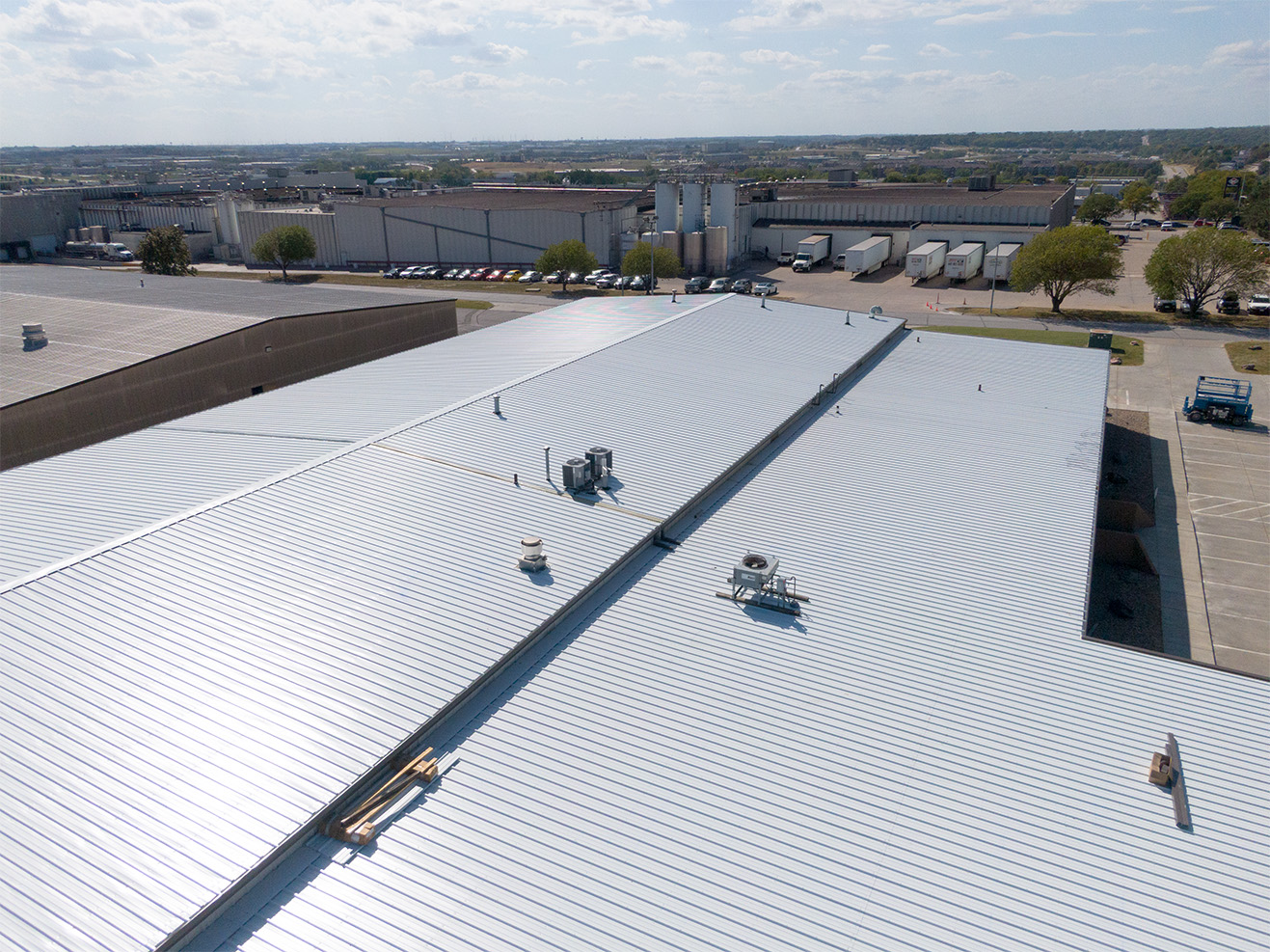
Standing seam metal is the dominant roof system on Tucson's resort properties, civic buildings, and high-end commercial construction - in part because the vertical panel geometry sheds monsoon rainfall efficiently and in part because Kynar-coated steel and aluminum panels are available in colors that meet Arizona's Solar Reflectance Index requirements. The design challenge in Tucson is the thermal cycle: 70-degree daily temperature swings in spring and fall drive significant panel expansion and contraction that the clip attachment system must accommodate.
Standing seam metal roofing uses raised, interlocking panel seams to create a weather barrier without exposed fasteners on the roof field. The concealed-fastener design eliminates the most common failure point on traditional metal roofing - exposed screw holes that open under thermal cycling - and allows the panels to float on clips that accommodate the dimensional changes that Tucson's extreme thermal environment demands.
Tucson's daily temperature swing is one of the most significant design inputs for standing seam metal in this market. Spring and fall mornings can start near 40°F and reach 90°F or above by afternoon - a 50-degree daily cycle. Winter nights in the Catalina Foothills can drop below 30°F following warm afternoons that reached 65°F. These cycles drive panel expansion and contraction that accumulates into stress at fixed points if the attachment system is not designed with sufficient clip travel. We specify clip travel and panel-to-panel joint geometry against the building's expected temperature range, not against a generic southwestern default.
Arizona's IECC 2018 Solar Reflectance Index requirements apply to metal roofs as they do to membrane systems. The Kynar 500 fluoropolymer coating finish used on most standing seam panels is available in a range of colors with documented SRI values - cool-color formulations that appear tan, gray, or terra cotta but reflect significantly more solar radiation than their visual appearance suggests. We document the panel's SRI value in the permit package and the warranty closeout.
Thermal Cycle Design in Tucson's Climate
A 20-foot steel standing seam panel in Tucson will expand approximately 0.28 inches between 30°F and 120°F - a temperature range that can occur within a single 24-hour period in spring or fall. Over a panel run of 100 feet, that cumulative movement is approximately 1.4 inches. Standing seam clip systems must accommodate this movement without allowing panel walking - the phenomenon where panels migrate horizontally over multiple thermal cycles, distorting the seam geometry and opening the interlocks.
Aluminum panels have approximately twice the thermal expansion coefficient of steel at equivalent temperature ranges, which makes clip travel design even more critical for aluminum standing seam in Tucson. The advantage of aluminum is its corrosion resistance in the alkaline dust environment of the Sonoran Desert - monsoon dust storms deposit mineralized particulate on all exposed surfaces, and steel panels without adequate coating integrity can corrode at scratch or cut-edge locations over time. We specify Galvalume steel or aluminum based on the building's use, environment, and budget, and we document the clip travel calculation in the project file.
Panel thermal expansion must also be accommodated at penetrations and curbs. A standing seam panel that is fixed at both a ridge and a penetration curb has no room to move - the panel will buckle or distort under thermal cycling. We design penetration details with elongated slots and flexible flashing assemblies that allow panel movement to occur without compromising the penetration seal.
Monsoon Performance of Standing Seam in Tucson
Standing seam metal's vertical panel geometry - seams raised 1.5 to 3 inches above the panel field - creates an inherently monsoon-resistant watershed. Monsoon convective rainfall in Tucson can produce short-duration intensities that overwhelm horizontal or low-slope waterproofing details on other system types. The raised seam keeps the panel-to-panel joint well above the water surface during peak rainfall events, eliminating the capillary-action failure mode that affects exposed-fastener metal and flat-seam systems under intense rainfall.
Gutters and downspouts on standing seam commercial buildings in Tucson should be sized for monsoon peak-flow rates rather than annual average rainfall intensity. The difference is significant: Tucson's annual average suggests modest gutter sizing, but the one-hour peak intensity of a monsoon convective event can be 3 to 4 times the annual average design value. We review gutter and downspout sizing on every standing seam project and flag undersized drainage as a scope item.
Haboob dust accumulation on metal roofs is a post-monsoon maintenance item in Tucson. The mineralized dust that accumulates in panel laps and at seam bases after a dust storm can hold moisture against the panel surface for extended periods after the storm passes. Annual cleaning and inspection of standing seam panels - particularly at seam bases, penetration flashings, and gutter lines - is standard practice in our maintenance program for Tucson metal roof buildings.
SRI Compliance and Kynar Coating Specification
Arizona IECC 2018 requires a minimum Solar Reflectance Index of 29 for steep-slope metal roofs and similar minimums for low-slope applications. Standard galvanized steel standing seam in unpainted or silver finish meets or exceeds these requirements. Painted panels require a Kynar 500 or equivalent fluoropolymer coating in an approved color - the coating manufacturer's published SRI values for the specific color are the compliance documentation.
Kynar 500 coatings are extremely durable in the Sonoran Desert UV environment - they are the same fluoropolymer chemistry used on exterior architectural metal cladding on buildings that must maintain color and reflectance over 25-plus year service lives. The coating's resistance to UV degradation and chalking is superior to standard polyester paint systems. We specify Kynar 500 on all standing seam commercial projects in Tucson and document the color and SRI value in the permit submittal and the project closeout file.
Cool-color Kynar finishes - formulations that use solar-reflective pigments to reflect near-infrared radiation even in medium and dark colors - are available from most panel manufacturers. These allow building owners to select colors in the tan, gray, bronze, and terra cotta ranges that complement Tucson's desert architecture without sacrificing the solar reflectance that Arizona energy code and membrane longevity require.
Frequently asked questions
Does standing seam metal qualify for Arizona energy code on commercial buildings in Tucson?
Yes, when specified correctly. Unpainted Galvalume steel standing seam meets IECC 2018 SRI requirements at standard specification. Painted Kynar 500 panels in approved cool-color formulations also meet requirements - the compliance documentation is the panel manufacturer's published SRI value for the specific color and coating. We include SRI documentation in the permit package for every standing seam project.
How do you handle thermal expansion on long standing seam panel runs in Tucson's temperature swings?
Standing seam clip systems are specified with sufficient travel - typically 1 to 1.5 inches on residential pitches and up to 2 inches on long commercial runs - to accommodate the panel dimensional changes that Tucson's 70-degree daily temperature swings produce. We calculate the expected expansion for the panel material, length, and temperature range specific to each building and document the clip specification in the project file. Penetration details are designed with elongated slots and flexible flashings that accommodate panel movement.
What maintenance does a standing seam metal roof on a Tucson commercial building require?
Annual inspection of seam integrity, fastener condition at any exposed trim locations, penetration flashings, and gutter and downspout performance. After monsoon season, we inspect for dust and debris accumulation in panel laps and at seam bases - mineralized Sonoran Desert dust holds moisture against panel surfaces and should be removed annually. Gutters and downspouts require post-monsoon cleaning to clear the sediment load that accumulates during intense convective rainfall events.
Standing seam metal roof project in Tucson?
Our project managers will assess the building's geometry, thermal exposure, and drainage requirements and produce a written specification with SRI compliance documentation, clip-travel calculation, and monsoon drainage review.
Ready to talk through a roof?
Tell us about the building and the roof problem. We'll document it and put a plan in writing - with an honest repair-vs-replace recommendation and no upsell pressure.
Documented, repair-first commercial & industrial roofing across Tucson and Pima County. Flat and low-slope systems for occupied buildings, planned around your operation.
Services
© 2026 Commercial Roofing Contractors Tucson. All Rights Reserved. Privacy Policy · Terms of UseSite Map