
Weather watch · Prepare your roof
Prepare for flood watch conditions in Marana
The National Weather Service has issued a flood watch covering Marana. Heavy rain and drainage loading can expose roof leaks, blocked drains, and ponding water. This is a weather exposure advisory; it does not establish damage to a specific roof.
Review your leak-response contacts and existing roof concerns. Arrange drainage checks only when safe. Follow official local weather guidance.
National Weather Service · Updated Sep 27, 2026, 4:17 AM UTC
Commercial Roofers in Marana, AZ
Commercial roofers serving Marana, AZ should document leak sources, wet insulation, drainage, edge details, penetrations, and repair history before recommending a scope. Commercial roof inspections, replacements, and maintenance for Marana's I-10 industrial corridor, Continental Ranch retail center, Marana Regional Airport business park, and the logistics and distribution buildout along Trico Road.
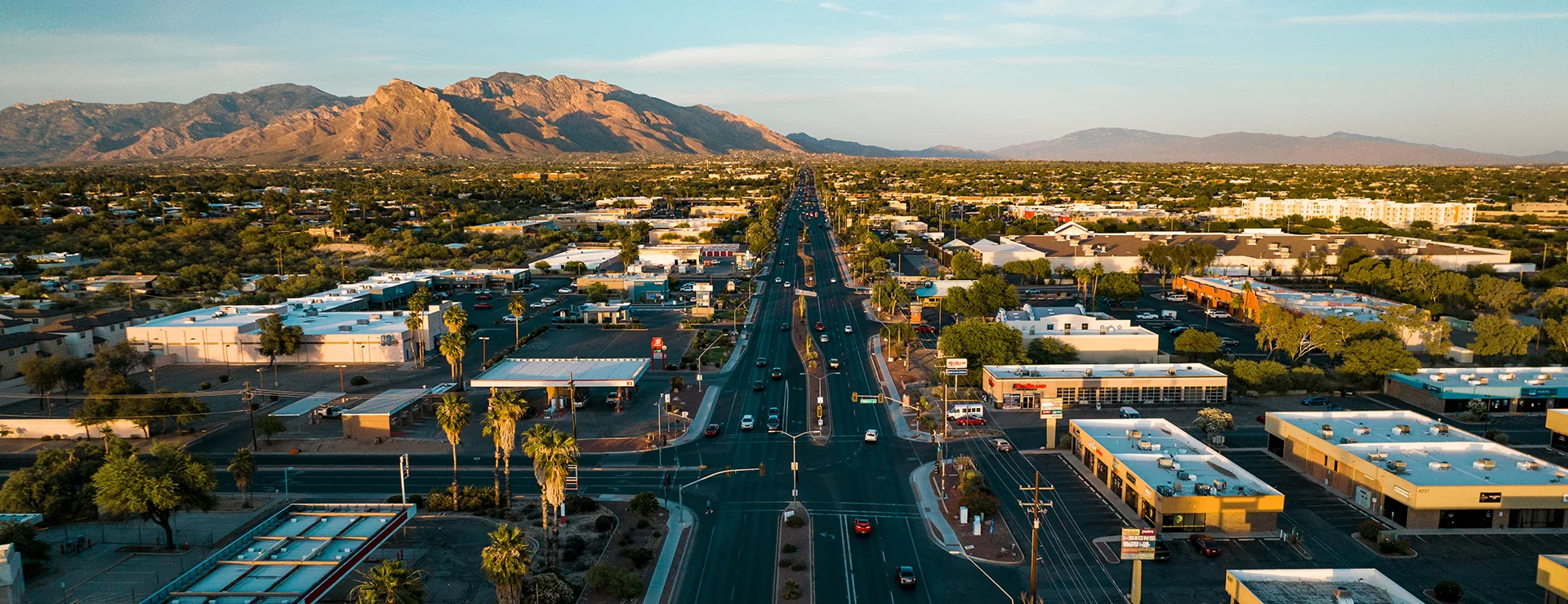
Marana's commercial base is centered on I-10 interchange logistics, the Marana Regional Airport business park, and the Continental Ranch retail and professional corridor - a mix of distribution-center flat roofs, aviation-adjacent industrial buildings, and retail strip centers that each carry distinct roofing requirements.
Marana sits on the northwest edge of the Tucson metro, straddling I- north to Pinal County. The town's growth over the past two decades has been driven by two engines: residential expansion in Continental Ranch and Dove Mountain, and industrial and logistics development along the I-10 frontage roads and the Marana Regional Airport perimeter. Those two growth patterns have produced different commercial roof inventories. The Continental Ranch corridor - Thornydale Road, Cortaro Farms Road, and Twin Peaks Road - is predominantly 2000s through 2010s retail and professional office construction, with roofing systems in the 15 to 25 year range now entering active replacement or recover cycles. The I- are newer, built to accommodate the distribution and light-manufacturing demand that continues to expand northwest of Tucson.
Marana's elevation ranges from roughly 1,900 feet near the Santa Cruz River bottomland to over 2,500 feet on the Dove Mountain residential ridges. Commercial buildings in the lower-elevation I-10 corridor face some of the most intense summer ambient temperatures in Pima County - Marana sits in a low basin that collects heat from the surrounding desert floor. UV Index exposure and rooftop surface temperatures on dark or oxidized membranes in this corridor regularly exceed what downtown Tucson measures at the same hour. We apply an elevation and terrain factor to every remaining-service-life assessment we write for Marana commercial buildings.
Marana Commercial Roof Inventory by Corridor
I-10 logistics and industrial corridor (Trico Road / Tangerine Road interchange): Distribution centers, light manufacturing, and logistics facilities in the 50,000 to 300,000 square foot range, most built 2005 through 2022. Roofing systems are predominantly 60-mil and 80-mil mechanically attached TPO and PVC on tapered polyiso insulation. Larger buildings in this corridor often have multiple roof zones at different elevations with separate drain systems - condition assessment requires a full zone-by-zone walk rather than a single drain-cluster inspection.
Marana Regional Airport business park (Avra Valley Road): Light industrial, aviation support, and general business buildings adjacent to the general aviation field. Airport-adjacent commercial buildings have specific considerations: aircraft operations require coordination for work scheduling on exposed roof sections, and some aviation-support facilities have clean-room or sensitive-instrument adjacency that requires odor and vibration management during membrane work. Town of Marana building permits and Marana Regional Airport Authority notifications are both required for work on airport-adjacent parcels.
Continental Ranch retail and professional corridor (Cortaro Farms Road / Thornydale Road): The primary retail spine of northwest Marana, with grocery-anchored centers, medical-office clusters, and restaurant pads built primarily 2002 through 2015. This is the submarket where first-replacement-cycle conversations are concentrated - roofing systems installed during the Continental Ranch buildout are now 10 to 20 years old, and the ones without documented maintenance programs are showing seam fatigue and drain-area ponding that indicates substrate saturation.
Twin Peaks Road and Dove Mountain commercial: Newer retail and professional buildings along the Twin Peaks Road corridor serving the Dove Mountain residential community. Construction dates range from 2010 through the present - most on first-generation TPO systems still within warranty. These buildings need documented annual maintenance to keep manufacturer warranties active through their service life.
Heat and UV Conditions in the Marana Basin
Marana's low-basin position along the Santa Cruz River corridor means it collects and holds ambient heat more intensely than higher-elevation Tucson locations. Summer afternoon ambient temperatures at Marana Regional Airport regularly exceed 108°F - several degrees higher than the downtown Tucson reading at the same hour. Rooftop surface temperatures on dark or oxidized membranes in the lower-elevation industrial corridor can reach 180°F. At those temperatures, standard-density polyiso insulation operates well below its labeled R-value due to thermal drift, and membrane polymer degradation accelerates significantly. We account for Marana's thermal environment when specifying replacement systems and when assessing remaining service life on existing roofs.
Monsoon season dynamics in Marana follow the regional pattern - July through September convective events - but with a local wrinkle: the Santa Cruz River floodplain runs north-south through the western part of the commercial area, and active monsoon events can produce flash flooding that affects building perimeter drainage. Roofs with scuppers or overflow drains that discharge to grade need to have their outlet elevations assessed against ground-level flood conditions during major monsoon events. We document scupper and overflow drain outlet conditions in our annual inspection reports for Marana commercial buildings.
Wind exposure in Marana's I-10 corridor is elevated compared to sheltered downtown Tucson sites. Buildings in the open industrial terrain along Trico Road and Tangerine Road are in ASCE 7 Exposure C classification - the highest open-terrain exposure - which drives corner and perimeter fastener patterns to higher density than buildings in the urban core. We pull the applicable wind-uplift pattern design for every Marana project based on the building's terrain classification and height.
Marana Permits and Jurisdiction Notes
Commercial roofing work in incorporated Marana requires permits from the Town of Marana Building Safety Division. Permit timelines for straightforward single-ply replacement projects are typically 5 to 8 business days. Marana adopted the 2018 International Building Code with Arizona amendments - energy code compliance documentation, including reflectivity and R-value calculations, is reviewed at submittal and must match the installed system exactly. We prepare the permit package and manage the submittal as part of every Marana project scope.
Some commercial parcels along the I- area fall within unincorporated Pima County jurisdiction rather than incorporated Marana. We verify jurisdiction on every project before permit submittal - the boundary in the northwest Tucson metro is not always obvious from address data alone. County Development Services permit timelines and inspection requirements differ from Marana's municipal process.
For logistics and distribution buildings with multiple-tenant configurations, we coordinate directly with property management on work-window scheduling, truck-dock access during roofing operations, and tenant notification for any odor-generating work. Large-footprint distribution buildings in the I-10 corridor often have operational constraints - 24-hour operations, refrigerated dock adjacency - that require pre-construction planning to address.
Frequently asked questions
How do you reach Marana from your Tucson office?
Marana is 20 to 30 minutes from our Tucson office via I-10 north. The I-10 industrial corridor and Marana Regional Airport area are on our regular northwest route. Emergency dry-in response for Marana commercial buildings is same-day for calls received before noon.
Do you work on large distribution center roofs in the I-10 corridor?
Yes. Large-footprint distribution and logistics buildings require zone-by-zone inspection walks, tapered drain-system assessment, and sequenced tear-off plans that keep active dock areas operational. We scope these projects with property management and logistics operations staff before contract execution to document work windows and tenant coordination requirements.
Does Marana use the same energy code as Tucson?
Marana, like Tucson and unincorporated Pima County, operates under the 2018 IECC with Arizona amendments - Climate Zone 2B reflectivity and R-value requirements apply. Compliance documentation is required at permit submittal and is reviewed before the permit is issued.
What membrane type is standard for Marana industrial buildings?
White or light-gray TPO and PVC are the predominant specifications in Marana's industrial corridor - reflectivity is required by Arizona energy code and reduces rooftop temperatures by 50 to 70 degrees, which meaningfully extends membrane service life in Marana's extreme heat environment. Larger warehouse buildings often use mechanically attached 80-mil systems for wind-uplift resistance in open-terrain exposure conditions.
Need a Marana commercial roof inspection or replacement scope?
Our project managers run regular routes through Marana's I-10 corridor, Continental Ranch, and the Airport business park. We will walk your roof, document the condition, and produce a written report for capital planning, warranty support, or pre-monsoon preparedness.
Ready to talk through a roof?
Tell us about the building and the roof problem. We'll document it and put a plan in writing - with an honest repair-vs-replace recommendation and no upsell pressure.
Documented, repair-first commercial & industrial roofing across Tucson and Pima County. Flat and low-slope systems for occupied buildings, planned around your operation.
Services
© 2026 Commercial Roofing Contractors Tucson. All Rights Reserved. Privacy Policy · Terms of UseSite Map