
Infrared Moisture Scanning in Tucson, AZ
Infrared thermography moisture detection for Tucson commercial flat roofs - identifying wet insulation under dry-looking membranes, validating recover-versus-replace decisions, and documenting moisture boundaries for insurance and capital planning.
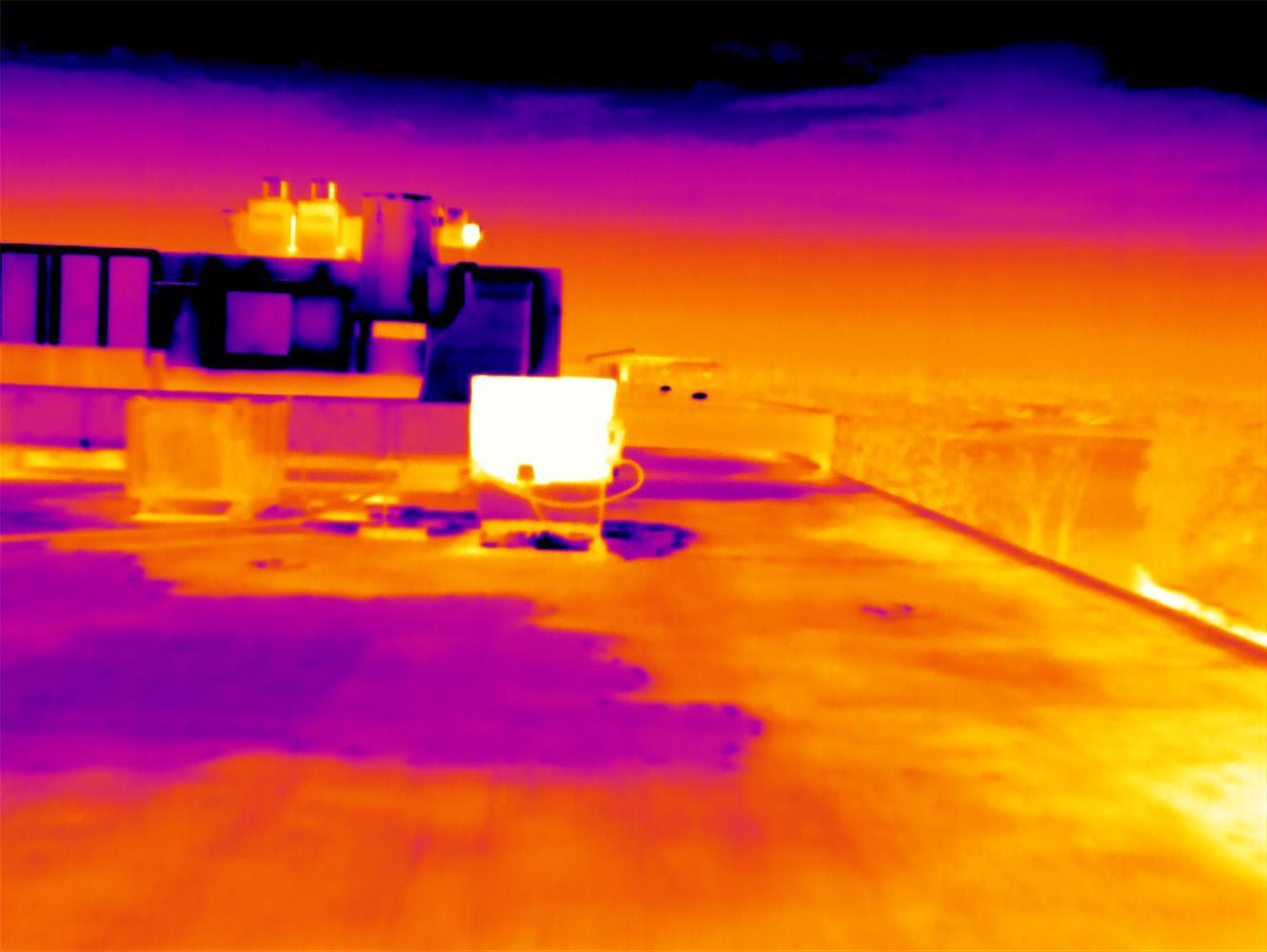
In the Sonoran Desert, low ambient humidity means a membrane can look intact and dry on the surface while the insulation underneath holds monsoon-infiltrated moisture that will not evaporate on its own. Infrared thermography maps that hidden saturation before you open the roof.
Tucson's low relative humidity creates a deceptive rooftop environment. In a humid climate, saturated insulation often shows surface evidence - blistering, persistent ponding, visible efflorescence. In the Sonoran Desert, the low ambient humidity pulls surface moisture away quickly, leaving a membrane that looks intact while the insulation below holds monsoon-delivered water that has been trapped under the membrane since July. Infrared thermography detects that trapped moisture by exploiting the thermal mass differential between wet and dry insulation: wet insulation retains daytime solar heat longer than dry insulation, producing a detectable warm signature on an evening scan.
Tucson's climate is actually better suited to infrared scanning than most other markets. The desert's extreme daytime solar loading differentially heats wet and dry insulation through the day, and the clear desert nights allow the surface to cool rapidly, maximizing the thermal contrast the scan depends on. We operate a FLIR thermal camera on Tucson commercial roofs in the evening - typically 45 to 90 minutes after sunset - during the April-through-October window when daytime solar loading is sufficient to create reliable contrast. The low humidity that makes moisture hard to detect visually is the same condition that makes the thermal differential sharp and reliable for infrared detection.
Infrared scanning is a decision-support tool, not a final answer. We use it in combination with core sampling: the scan identifies the suspect zones, and cores confirm moisture content. For recover-versus-replace decisions on Tucson warehouse, office, and medical-office buildings in the 20,000 to 200,000 sq ft range, this combination consistently produces more accurate scoping than a visual inspection alone - and costs far less than speculative tear-off.
When Infrared Scanning Is Appropriate in Tucson
Pre-recover decision: Before committing to recover versus full replacement on an aging Tucson roof, an infrared scan documents how much existing insulation is dry and recoverable. If less than 25% of the roof reads as wet, recover with targeted insulation replacement is typically sound. If more than 25% is wet, replacement is the honest scope - recovering wet insulation traps moisture, voids the new system warranty, and accelerates deck corrosion under Tucson's sustained heat cycle.
Post-monsoon assessment: After a significant monsoon event or a storm sequence that overwhelmed the roof's drainage capacity, infrared scanning identifies moisture infiltration that may not be visible as an obvious surface breach. The mechanism is common on Tucson roofs: UV-stressed seams that held all summer open slightly under monsoon rainfall, allow water to wick under the membrane, and then re-seal as the surface dries - leaving no visible evidence of the entry. Infrared scanning finds the wet insulation beneath.
Pre-sale or pre-refinance documentation: Buyers and lenders increasingly request infrared moisture scan reports as part of commercial roof due diligence on Tucson transactions. We produce signed, dated scan reports with thermal images and a written moisture boundary summary for this purpose.
Warranty investigation: When a building owner believes a roof is leaking but the contractor disputes the source, an independent infrared scan produces an objective moisture-location record. We have conducted third-party scans on buildings across the Midtown, University District, and Foothills commercial corridors.
How We Conduct the Scan in Tucson
Timing is critical. The scan must occur after sufficient daytime solar loading and after the surface has begun to cool. In Tucson, the intense Sonoran Desert solar load from April through October means the differential between wet and dry insulation develops reliably - the desert sun heats the roof surface to 150°F or higher, and wet insulation absorbs and holds that heat while dry insulation cools. We typically begin the scan 45 to 60 minutes after sunset. Tucson's clear desert skies, with nearly zero cloud cover on most evenings outside monsoon season, make the thermal re-emission from the roof surface consistent and unobstructed.
We walk a grid pattern across the roof, capturing overlapping thermal frames with GPS coordinates at each position. Thermal images are stitched into a roof plan overlay showing warm (suspect-wet) zones against the cooler dry field. All thermal images are saved with camera metadata intact - date, time, ambient temperature, camera settings - for the report documentation.
Core sampling follows: we pull 3-inch cores at the centroid of each warm zone identified and two control cores in areas the scan read as dry. Cores confirm moisture content and verify the scan accuracy. On Tucson roofs with good pre-scan solar loading, the thermal read is accurate within approximately one zone of the confirmed wet boundary.
What Infrared Scanning Cannot Tell You
Infrared scanning reads moisture in the insulation layer directly below the membrane - not in the structural deck, not in the building interior. Deck corrosion or deflection is a visual and probe finding, not a thermal one.
The technique is most reliable on Tucson commercial roofs during the April-to-October window when daytime solar loading is strong enough to establish the thermal differential. December and January scans, when solar angles are lower and cloud cover occasionally reduces the loading, produce less reliable contrast. We advise clients on optimal scan timing for their building's orientation and exposure.
Rooftop HVAC units create localized warm zones that can be confused with moisture anomalies or mask adjacent wet insulation. Tucson commercial buildings tend to have heavy rooftop HVAC equipment due to the cooling load, which means more potential interference zones than in northern markets. We flag HVAC equipment zones in the scan report and verify them by core or probe rather than treating them as confirmed moisture findings.
A scan report is a planning document, not a warranty. We do not warrant the scan as a complete inventory of all moisture in the assembly - the report describes what infrared imaging detected and where cores confirmed moisture, giving the owner the information needed to scope repair or replacement intelligently.
Frequently asked questions
Does Tucson's low humidity make infrared scanning more or less reliable?
More reliable. Low ambient humidity means the thermal differential between wet and dry insulation is sharper - surface moisture does not mask the re-emission from the insulation layer the way it can in a humid climate. Tucson's intense daytime solar load also creates a strong heat input to the insulation, maximizing the retained-heat signal that wet insulation produces on an evening scan. The clear desert skies, which provide consistent solar loading and unobstructed nighttime thermal re-emission, are close to ideal conditions for this technique.
Do you scan during the day or at night?
Evening, after sunset. Tucson's daytime rooftop surface temperatures in summer make midday scanning completely unreliable - the radiant heat from the membrane overwhelms any differential from the insulation below. The window 45 to 90 minutes after sunset in the April-through-October period is when thermal contrast between wet and dry insulation is at its most readable.
Can the scan report be used for a monsoon damage insurance claim?
Yes, with the understanding that the scan documents moisture presence, not cause. If you need an insurance-grade report that also establishes cause - monsoon event versus pre-existing UV degradation - we structure the report to address that distinction and will coordinate with your adjuster on their documentation requirements.
Not sure if your Tucson roof needs replacement or recover? Scan it first.
An infrared scan and a handful of cores gives you the moisture map you need to make a sound capital decision - without opening the roof across the full area and guessing.
Ready to talk through a roof?
Tell us about the building and the roof problem. We'll document it and put a plan in writing - with an honest repair-vs-replace recommendation and no upsell pressure.
Documented, repair-first commercial & industrial roofing across Tucson and Pima County. Flat and low-slope systems for occupied buildings, planned around your operation.
Services
© 2026 Commercial Roofing Contractors Tucson. All Rights Reserved. Privacy Policy · Terms of UseSite Map