
Commercial Roofers in University of Arizona Area, AZ
For commercial properties in University of Arizona Area, AZ, the defensible choice between repair, restoration, and replacement starts with roof-system condition, moisture findings, drainage performance, and remaining service life. Commercial roofing for UA campus buildings, Banner University Medical Center on Campbell Avenue, Park Place Mall area, and the University Boulevard and Speedway commercial corridors.
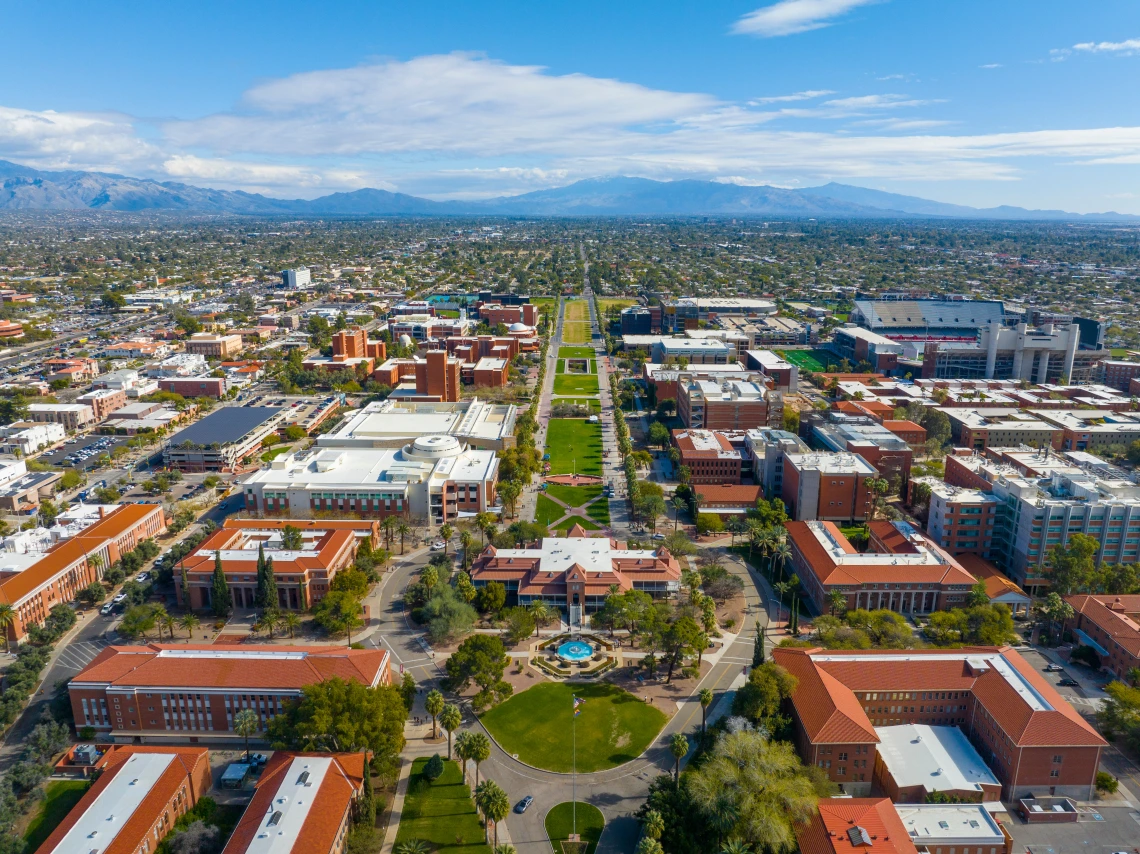
The UA area bundles one of the Southwest's largest research university campuses, Banner University Medical Center Tucson on Campbell Avenue, and the Park Place Mall commercial cluster into a dense institutional and commercial zone east of Downtown - each building type with distinct roof work requirements and procurement paths.
The University of Arizona's main campus spans more than , Park Avenue, and Campbell Avenue, with academic, research, laboratory, and athletic buildings ranging from 1920s masonry construction to 2020s net-zero research facilities. The oldest campus buildings have been through multiple roof cycles; the newest are on first-generation systems designed to current Arizona energy code. UA Facilities Management oversees all roof work on campus under a formal procurement process - we work within that process and deliver the documentation formats UA's systems require.
Banner University Medical Center Tucson on North Campbell Avenue - the former University Medical Center - is one of Arizona's flagship academic medical centers, with acute care towers, clinical buildings, and research facilities that place demanding constraints on roof work. Infection-control requirements, hot-work permit protocols, off-hours scheduling for any occupied-floor adjacency, and construction odor management are non-negotiable at this campus. We have a pre-construction meeting protocol specifically for healthcare facilities that covers all of these requirements and produces a written work plan that the Banner facilities team approves before project start.
The Park Place Mall area along East Broadway Boulevard adds a third inventory type: large-format retail, medical office, and mid-rise professional buildings from the 1980s and 1990s that are now reaching active reroof cycles. The Speedway Boulevard and Grant Road corridors running east from Campbell represent dense mixed-use commercial inventory - restaurant, retail, professional office - with the pedestration density and scheduling constraints typical of active urban commercial corridors.
UA Campus Procurement and Building Types
University of Arizona campus buildings require contractor registration with UA Procurement and BPA (Business Privileged Access) credentialing for crew members working in occupied campus areas. We maintain active UA contractor registration and manage the credentialing process for all crew members on campus projects. Documentation deliverables - as-built drawings, warranty certificates, inspection reports - are submitted to UA's facilities management systems in formats their records management requires.
UA building stock presents unusual technical variety for a single institution. The 1920s and 1930s masonry buildings on the historic core of campus have wood decks, clay-tile roof elements, and parapet details that require careful substrate assessment before any waterproofing work. Mid-century academic buildings (1950s through 1970s) typically carry original BUR systems on steel decks. Modern research and laboratory buildings (1990s through 2020s) are on single-ply membrane systems with rooftop mechanical loads that reflect the HVAC requirements of laboratory and clean-room spaces.
UA Tech Park on Rita Road - a separate UA-affiliated research and technology campus on Tucson's southeast side - houses technology and defense-sector tenants including Ventana Medical Systems (Roche Group), IBM research operations, and multiple defense contractors. Tech Park buildings are separate from main campus procurement but often use the same documentation standards. Several Tech Park tenants have security access requirements that require advance contractor registration and escort protocols.
Banner University Medical Center Tucson
Banner UMC Tucson operates acute care, surgical, oncology, and research functions across multiple interconnected buildings on the Campbell Avenue campus. Any roof work with the potential to affect indoor air quality - torch-down operations, solvent-based adhesives, or demolition of materials with asbestos potential in older sections - requires coordination with Banner's infection-control team and typically triggers an air-quality monitoring protocol for adjacent occupied spaces.
Hot-work permits at Banner UMC require written approval from the facility's fire safety officer. We initiate the hot-work permit process at least five business days before any torch or welding operation on the campus. For projects that can specify a cold-adhesive or mechanically attached system, we do so specifically to avoid the hot-work permit timeline and coordination burden.
Off-hours scheduling is standard for any roof section adjacent to occupied patient care floors. We build night-shift and weekend production windows into the project schedule for any work within sound or vibration distance of patient rooms or intensive-care areas. Production pace is slower in off-hours configurations, and the project timeline for Banner UMC work reflects that reality from the first written scope.
Park Place and University Corridor Commercial Stock
Park Place Mall on East Broadway Boulevard anchors a commercial cluster that includes big-box retail, medical-office buildings, and the East Broadway commercial corridor running toward Craycroft Road. The mall structure and its attached anchor pads are 1980s-era construction on original EPDM and modified-bitumen systems - most sections have been recovered or repaired multiple times and carry complex layered profiles that need core work before any new scope is written.
The Speedway Boulevard commercial corridor between Campbell and Craycroft Road is heavy with 1970s and 1980s medical-office, professional-office, and service-commercial buildings. These buildings are smaller footprint - 5,000 to 30,000 square feet - with high penetration counts from HVAC and medical equipment. Penetration count drives labor cost on smaller buildings more than square footage, and the scheduling constraints of active medical-office operations typically push roof work into evening and weekend windows.
Grant Road between Campbell and Country Club Road adds a dense strip of retail and restaurant buildings where tenant operations constrain scheduling more than weather. Restaurant pads require sequencing around kitchen hours, and the HVAC penetration work on these buildings must be coordinated with kitchen operations to prevent debris from entering exhaust systems. We identify tenant scheduling constraints in the pre-construction assessment and build them into the daily production plan.
Frequently asked questions
How do you handle UA campus contractor registration and badging?
We maintain active University of Arizona contractor registration and manage BPA credentialing for all crew members assigned to campus projects. The credentialing process takes two to four weeks for new crew members - we initiate it at contract execution, not at mobilization. Documentation deliverables are submitted in the formats UA Facilities Management requires, including as-built drawings keyed to UA's campus building numbering system.
What is your protocol for infection-control coordination at Banner UMC Tucson?
We hold a pre-construction meeting with Banner's infection-control team and facilities management before every campus project. That meeting produces a written work plan that documents odor-generating operations, hot-work permit timelines, off-hours scheduling windows for occupied-floor adjacency, and the air-quality monitoring protocol if required. The written work plan is approved by Banner before crew mobilization.
Can you assess a Park Place area building for recover versus full replacement?
Yes. Recover - installing a new single-ply membrane over the existing system with a cover board - is often the right capital call on Park Place-era buildings where the existing insulation is dry and the deck is sound. We pull moisture cores to verify substrate condition before writing any scope. If the core data supports recover, we provide the recover specification and cost alongside the full-replacement option so the owner can make the decision on current condition data.
Do you pull University of Arizona area building permits?
For commercial buildings in the City of Tucson jurisdiction adjacent to campus - on Broadway, Speedway, Grant, or Campbell - we pull City of Tucson building permits and manage the submittal process. Work on UA-owned buildings on main campus goes through UA Facilities Management's internal authorization process, which has its own documentation and inspection requirements separate from city permitting.
Get a UA area commercial roof inspection or scope.
Our project managers are experienced with UA campus procurement, Banner UMC healthcare protocols, and the Park Place and Broadway commercial corridors. We produce written condition reports, moisture-core documentation, and permit-ready scopes for institutional, healthcare, and private commercial buildings in this area.
Ready to talk through a roof?
Tell us about the building and the roof problem. We'll document it and put a plan in writing - with an honest repair-vs-replace recommendation and no upsell pressure.
Documented, repair-first commercial & industrial roofing across Tucson and Pima County. Flat and low-slope systems for occupied buildings, planned around your operation.
Services
© 2026 Commercial Roofing Contractors Tucson. All Rights Reserved. Privacy Policy · Terms of UseSite Map