
Roof Replacement Planning in Tucson, AZ
Pre-construction planning, permits, monsoon-season sequencing, and closeout documentation for Tucson commercial roof replacement - everything before and after the membrane goes on.
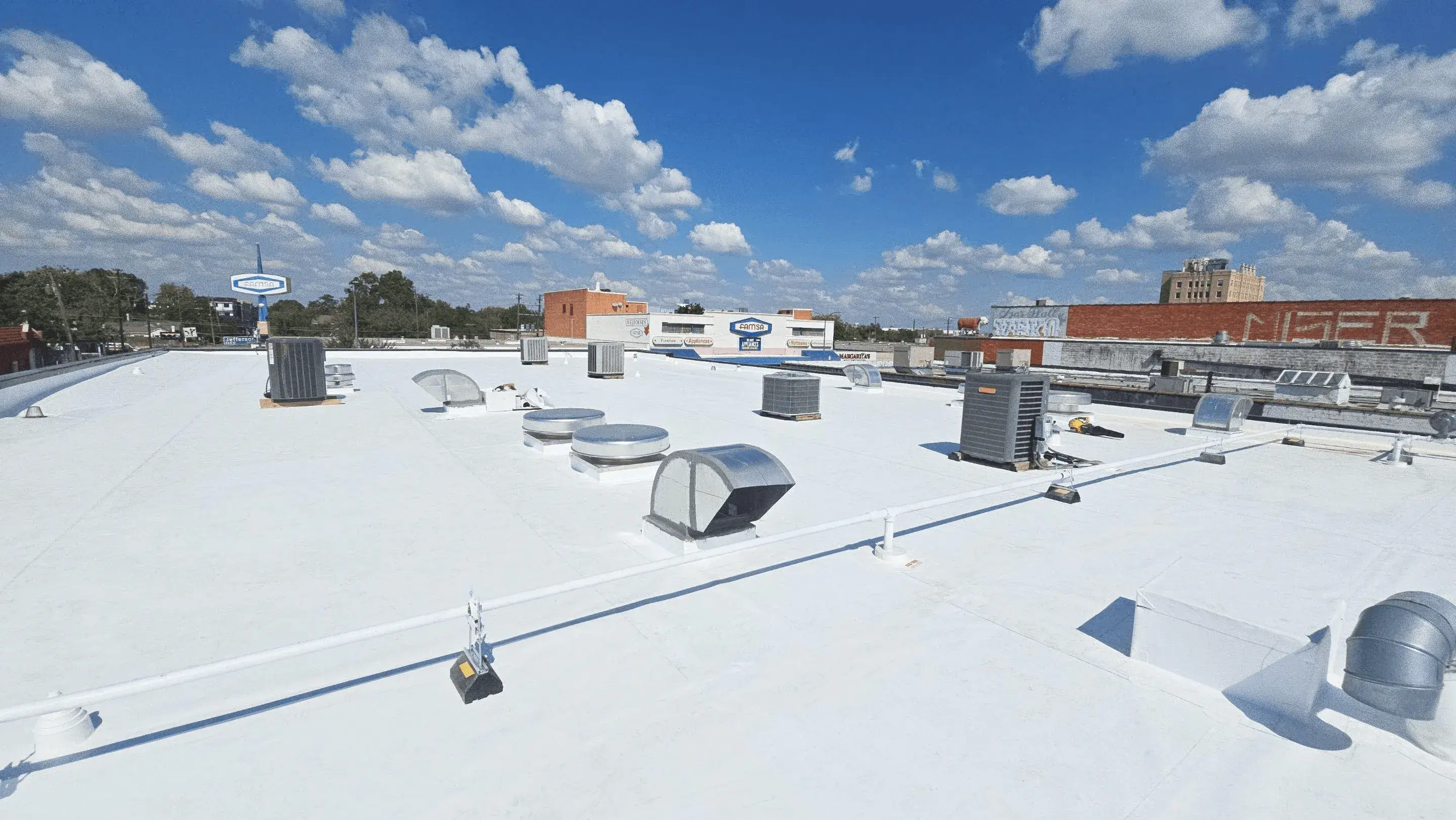
The installation is the shortest part of a Tucson commercial roof replacement. Pre-construction planning - permits, monsoon dry-in sequencing, tenant notification, crane staging - and a complete closeout package are what determine whether the project holds up, the warranty stays valid, and the building's next facility manager understands what system is on the roof.
Most commercial roof replacement problems in Tucson are not membrane failures. They are planning failures. The replacement was scoped reactively after a monsoon event, bid in two weeks, awarded on price alone, and started without a written monsoon dry-in protocol. A section was left open overnight when afternoon thunderstorms arrived from the Santa Catalinas. The tenant found out about the crane the morning it appeared. The closeout package was a warranty card in a filing cabinet.
We treat pre-construction planning and closeout documentation as non-negotiable components of every Tucson replacement project. Monsoon season adds a sequencing discipline to Tucson commercial roofing that does not exist in most other markets: no section open overnight from July through September, production section sizes set by the crew's realistic same-day dry-in capacity, and weather monitoring active throughout every production day. These are written into the project schedule before contract execution, not improvised during production.
Tucson adds specific permitting and coordination complexity beyond what suburban markets face. The City of Tucson Development Services Center processes commercial roof permits with typical turnaround of 7-10 business days for complete applications. University of Arizona Facilities Management oversees all roof work on campus and Tech Park properties. Banner Health hospital campuses require infection-control coordination, hot-work permits, and off-hours scheduling for occupied floor adjacency. Davis-Monthan AFB contractor work requires security-clearance documentation and coordination with base operations. We manage these requirements as part of every project, not as extras.
Pre-Construction: Permits, Mobilization, and Tenant Notification
Permits: We submit the building permit application with the full construction document package - system specification, product data, insulation R-value compliance calculation, IECC reflectivity documentation, fastener pattern calculation - at contract signing for City of Tucson or Pima County projects. For UA campus work, we submit to UA Facilities Management's project documentation system in parallel. We do not schedule mobilization against an assumed permit timeline; we build the actual permit review window into the project schedule.
Mobilization plan: We produce a written mobilization plan that covers material delivery staging, crane or hoist location and outrigger pad requirements, dumpster placement - Tucson's urban corridors and the 4th Avenue area require coordination with the City of Tucson right-of-way office for on-street equipment placement - and parking impact for the building's tenants. For Banner Health campuses and hospital facilities, the mobilization plan is submitted to the facilities management team for written approval before any crew activity begins on site.
Tenant notification: We draft the notification letter through the property management team at minimum 14 days before mobilization. The letter covers production start date, expected duration, what tenants will experience, how emergency building access is maintained throughout the project, and a direct contact for tenant concerns. We issue a second notification 48 hours before start and a daily update on days where production sequence moves to a new building zone - this is especially important on multi-tenant medical office and retail buildings where operations scheduling depends on knowing when work will be adjacent to their space.
Monsoon-Season Sequencing - Tucson's Non-Negotiable
From July 1 through September 30, no roof section is left open overnight on any Tucson project we run. This is not a weather-dependent policy; it is a standing protocol. The National Weather Service Tucson office can issue a Flash Flood Watch within 30 minutes of storm initiation, and convective cells over the Rincon and Santa Catalina mountains can reach a commercial job site in central Tucson before the warning is broadcast. We do not take that risk with a building's interior.
Section size during monsoon season is set by the crew's realistic same-day dry-in capacity on each production day, accounting for morning cloud cover that may delay start and afternoon monsoon probability. On a standard Tucson commercial flat roof, same-day section size typically runs 4,000-7,000 sq ft during monsoon season, compared to 8,000-12,000 sq ft during the October-June production window. Monsoon-season replacement projects take longer; the written project schedule documents this before contract execution so the owner is not surprised by the timeline.
Summer morning scheduling: we start Tucson summer production at 5:30 AM. TPO and PVC membrane application in the Sonoran Desert afternoon is temperature-limited - substrate temperatures on dark surfaces exceed 160°F by midday in July and August, and hot-air weld quality degrades above that range. Starting early is not a convenience; it is a quality-control requirement that we write into every summer project plan.
Closeout Package - What Tucson Building Owners Need
The closeout package is the permanent record of the project. It is what the manufacturer's warranty inspector references when a claim is filed, what the UA Facilities Management system requires for their building asset records, what a Banner Health campus requires before final payment, and what the building's next buyer or lender reviews during due diligence.
Our Tucson closeout package includes: the manufacturer's warranty document with registration confirmation and the registration number that allows online verification; the roof zone diagram with all zones labeled, drains and scuppers marked, all penetrations documented, and all closeout photos keyed to their location on the plan; the project specification and product data sheets for every installed material; the fastener pattern calculation record; the IECC reflectivity and R-value compliance documentation for the City of Tucson or Pima County energy-code file; the permit and inspection record; the pre-monsoon maintenance schedule with specific items required to maintain the warranty; and contact information for our maintenance program.
We deliver the closeout package digitally and in hard copy within seven business days of the manufacturer warranty inspection walkthrough. We submit the warranty registration to the manufacturer at project completion - we do not leave that step to the owner to initiate.
Frequently asked questions
How long does permitting take for a commercial roof replacement in Tucson?
City of Tucson Development Services Center processes commercial roof permits in approximately 7-10 business days for complete applications. Pima County Development Services runs a similar timeline for unincorporated county projects. UA campus and Tech Park projects are submitted to UA Facilities Management and follow their project documentation review process, which varies by project scope. We submit complete permit packages at contract signing and build the actual review timeline into the project schedule.
What happens if a monsoon event arrives during my Tucson roof replacement?
During monsoon season, the production section size is set so that whatever is torn off in a day can be dried in the same day before crew departure. If a monsoon event arrives during a production day, the crew secures and tarps whatever is open and does not leave the site until the section is watertight. Daily section sizes during monsoon season reflect this discipline - owners see smaller daily production numbers, but nothing gets left open.
Do you work on Banner Health and hospital campuses in Tucson?
Yes. Banner University Medical Center Tucson, Oro Valley Hospital, TMC HealthCare, St. Joseph's, and St. Mary's all require infection-control coordination, hot-work permits, and off-hours scheduling for occupied floor adjacency. We have a pre-construction meeting protocol for healthcare facilities that covers all of these requirements and produces a written work plan that the facilities management team approves before any crew activity begins on site.
Planning a roof replacement on a Tucson commercial building?
Our project managers will walk the roof, produce the replacement scope, and walk you through the full project plan - permits, mobilization, monsoon sequencing, and closeout - before you commit to a contract.
Ready to talk through a roof?
Tell us about the building and the roof problem. We'll document it and put a plan in writing - with an honest repair-vs-replace recommendation and no upsell pressure.
Documented, repair-first commercial & industrial roofing across Tucson and Pima County. Flat and low-slope systems for occupied buildings, planned around your operation.
Services
© 2026 Commercial Roofing Contractors Tucson. All Rights Reserved. Privacy Policy · Terms of UseSite Map