
Replacement vs. Recover Analysis
Documented replacement-vs-recover decision framework for Tucson commercial buildings - moisture coring, deck condition assessment, Sonoran silicone restoration LCC math, warranty status, and capital horizon alignment. Written recommendation with supporting data.
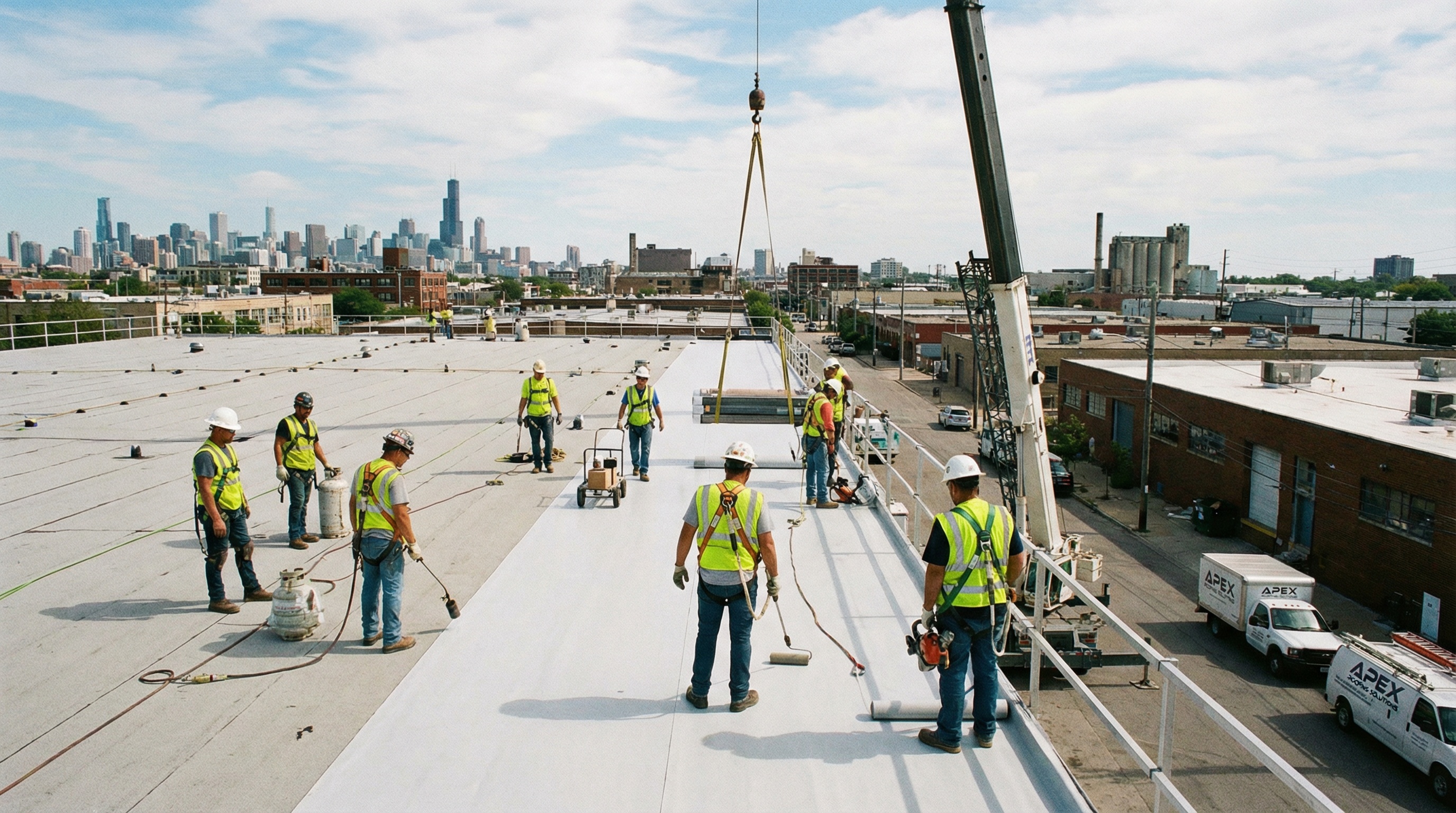
We apply a documented decision framework to the recover-or-replace question on aging Tucson commercial roofs - moisture coring, deck condition, silicone restoration LCC math vs. full tear-off, warranty status, and capital horizon - and deliver a written recommendation the owner can take to a capital committee.
The replacement-vs-recover decision is the highest-stakes choice in commercial roof asset management in the Tucson market. A silicone restoration coating or single-ply recover at 35 to 55 percent of full replacement cost is only worth taking if the existing insulation is dry, the deck is sound, and the capital horizon supports the extend-now-replace-later strategy. A recovery application over wet or UV-compressed insulation traps moisture, accelerates deck corrosion under Sonoran heat, and voids the new warranty - converting a $250,000 coating project into a $600,000 emergency replacement within three to five years.
We apply a structured decision framework to this question on every aging Tucson commercial building we assess. The framework is not a sales tool for larger projects - we have recommended silicone restoration on buildings where a full replacement would have generated significantly more project revenue. The recommendation goes where the core data goes. Tucson owners and asset managers use our recover analysis as a capital planning input because the recommendation is built on field data, not on project size preference.
The deliverable is a written report with the supporting data: moisture survey results with a core-location map, deck condition findings, warranty status documentation, Sonoran-specific silicone restoration LCC math, and capital horizon analysis. The report is formatted so the owner can take it to a capital committee, a lender, or a board without needing us in the room to explain it.
The Four-Part Decision Framework for Tucson Buildings
Part 1 - Moisture distribution: We core the existing roof system at a density of one core per 2,000 to 3,000 sq ft of roof area, with additional cores at known wet areas identified by prior leak reports or infrared scan results. Each core is measured with a calibrated moisture meter and photographed. In Tucson, the saturation pattern is often non-uniform - UV degradation softens membrane seams at parapet-adjacent zones and drain pans first, so early-season monsoon water enters the insulation in concentrated locations while field areas remain dry. We core at the statistically expected wet locations as well as at the mid-field grid points. If more than 20 percent of roof area is wet (our threshold, which matches most manufacturer recover-warranty requirements), we recommend replacement. Below that threshold, the recover path is moisture-viable. Between 20 and 25 percent, the distribution matters - concentrated wet areas that can be surgically replaced during recover are a different situation than diffuse saturation across the field.
Part 2 - Deck condition: In Tucson, metal deck corrosion under wet insulation is accelerated by the combination of extended moisture contact under Sonoran heat and the alkaline runoff from certain parapet coping materials common in southwestern commercial construction. We pull inspection ports at wet core locations and at any visible deck deflection points. Corroded metal deck at drain sumps - the most common location in Tucson due to blocked or slow-draining sumps - fails the recover path regardless of the insulation saturation percentage. A building with 12 percent wet insulation and corroded deck under the wet areas needs full replacement plus deck repair, not a recover.
Part 3 - Warranty status: An active manufacturer warranty on the existing system is a material factor in the Tucson recover decision. Some manufacturers offer warranty term credit toward a new manufacturer warranty when the existing system is still in-warranty at recover time - Carlisle offers warranty term credit under specific conditions; Sika Sarnafil has a recover-over-existing program for qualified substrates. We document the existing warranty status, remaining term, and whether the recover path qualifies for any warranty credit or continuation from the current manufacturer. For Tucson buildings with active NDL warranties, losing that warranty coverage by choosing a non-qualifying recover path is a real financial impact that belongs in the LCC comparison.
Part 4 - Capital horizon: Silicone restoration over a qualified Sonoran substrate extends asset life 10 to 15 years depending on the coating specification and maintenance program. A single-ply recover adds 15 to 20 years. The capital horizon analysis asks: when does the owner plan to sell, refinance, or schedule the next major capital event? If the horizon is 8 years, a silicone restoration that extends asset life 12 years is the correct capital call. If the horizon is 20 years and a silicone restoration will need a second application or a full replacement at year 13, two capital events in the same planning window may cost more than one full replacement now. We model both paths explicitly.
Sonoran Desert Factors in the Recover Decision
UV-compressed insulation that reads as dry: A uniquely Sonoran challenge. Polyiso insulation that has been subjected to sustained 175°F-plus rooftop surface temperatures for more than 10 years can exhibit compressive deformation - the board loses thickness and loses effective R-value - without showing moisture saturation that a meter detects. Compressed insulation under a recover or coating system creates drainage problems because the slope-to-drain relationship has shifted. We include a visual assessment of insulation board condition and thickness against the original specification at each core location.
Monsoon-season application windows: Silicone restoration coatings require a dry substrate and a dry application window. In Tucson, the only reliable application window outside monsoon risk is October through June. A recover project that misses the spring application window waits until fall. We flag this in the capital timeline analysis - a recover decision made in August may not be executable until October or November, which affects the capital commitment date.
Arizona Insurance Code considerations: Commercial building insurers operating under AZ Insurance Code oversight have begun asking for roof condition documentation - specifically moisture survey results and recovery or replacement recommendation letters - on Pima County commercial properties at renewal. An owner with a written recover recommendation supported by core data is in a materially different position at insurance renewal than an owner who cannot document the roof system's current condition. We note this in the recommendation letter and format the core log so it is readable by an underwriter, not just a roofing contractor.
What the Written Report Contains
Core log: Core location (GPS coordinates keyed to roof zone diagram), layer-by-layer description (membrane, cover board, insulation type and thickness, any prior recover layers, vapor barrier, deck type), moisture reading at each layer, and photograph of each core. The core log is the primary data source for the moisture distribution assessment and the document a manufacturer needs to evaluate recover-warranty eligibility in the Tucson market.
Deck condition summary: Inspection port findings and photographs, with a map of locations assessed. Any conditions that affect the recover recommendation - corrosion at drain sumps, deflection at mid-field points, coping-material runoff staining - are called out explicitly with photographs.
Warranty status documentation: Existing warranty document (obtained from owner's records or reconstructed from the manufacturer's warranty desk using building location and approximate install date), remaining term, and the manufacturer's stated recover-warranty policy for the specific existing membrane type on this building.
Sonoran silicone restoration LCC vs. full tear-off: Side-by-side capital cost comparison including installed cost range for each path at current Tucson pricing, the annual maintenance cost difference between the paths, the probability-weighted cost of a failed restoration scenario (substrate does not qualify, full replacement required), and the NPV comparison over the owner's capital horizon. This is not a full LCC model - it is a decision-focused cost summary formatted to support the recommendation.
Recommendation and supporting rationale: Clear written recommendation - recover or replace - with the data points that drive it. When the data supports a borderline case, we present both options with the factors that would tip the decision either way and let the owner make the call with full information.
Frequently asked questions
How many cores do you pull on a typical Tucson commercial building?
One core per 2,000 to 3,000 sq ft of roof area as the baseline distribution, plus additional cores at all reported leak locations, at drain pan fields, at parapet-adjacent zones where UV degradation typically concentrates moisture entry, and at any area flagged by infrared scan. On a 75,000 sq ft building, we typically pull 28 to 40 cores. The core log is delivered with every report.
Can we do a silicone restoration if part of the roof is wet?
In many cases, yes. If wet areas are concentrated and below 20 percent of total roof area, a hybrid scope often works: remove and replace the wet insulation at wet locations, coat over the dry areas. This is a selective-restoration scope - it increases the coating project cost slightly but avoids full replacement cost. We have executed this approach on Tucson buildings where full replacement was not warranted by the data.
Do you recommend one coating manufacturer for Tucson silicone restoration?
No. We specify by performance requirement - minimum elongation, minimum tensile strength, minimum solar reflectance value for Arizona IECC 2018 Climate Zone 2B compliance - and present the manufacturer options that qualify for a recover warranty over the specific existing membrane type on your building. Manufacturer recover-over-existing warranty policies vary: some issue new NDL warranties over qualified recovered systems; others will not. We document which manufacturers' coating systems are eligible over your existing membrane.
How long does the recover-or-replace assessment take on a Tucson commercial building?
Site visit for core pulls and deck inspection: one day for a building up to 120,000 sq ft, longer for larger footprints or complex access. Report delivery: five business days from site visit. If infrared scanning is included - which we recommend for any building with reported leaks across a wide area - add one additional site visit and two to three business days to the report timeline. Infrared scanning in Tucson is most effective on clear evenings in spring or fall when the daily thermal differential between wet and dry insulation is at its maximum.
Facing the recover-or-replace decision on a Tucson commercial building?
We will pull cores, assess deck condition against Sonoran heat and moisture history, document warranty status, run the silicone restoration LCC math against full tear-off, and deliver a written recommendation - so your capital committee has what it needs to make the call.
Ready to talk through a roof?
Tell us about the building and the roof problem. We'll document it and put a plan in writing - with an honest repair-vs-replace recommendation and no upsell pressure.
Documented, repair-first commercial & industrial roofing across Tucson and Pima County. Flat and low-slope systems for occupied buildings, planned around your operation.
Services
© 2026 Commercial Roofing Contractors Tucson. All Rights Reserved. Privacy Policy · Terms of UseSite Map