
Roof Moisture Survey Services in Tucson
Commercial roof moisture surveys for Tucson buildings - core sampling protocol, moisture distribution mapping, and recover-versus-replace decision support calibrated to the monsoon saturation patterns common in Sonoran Desert roof inventory.
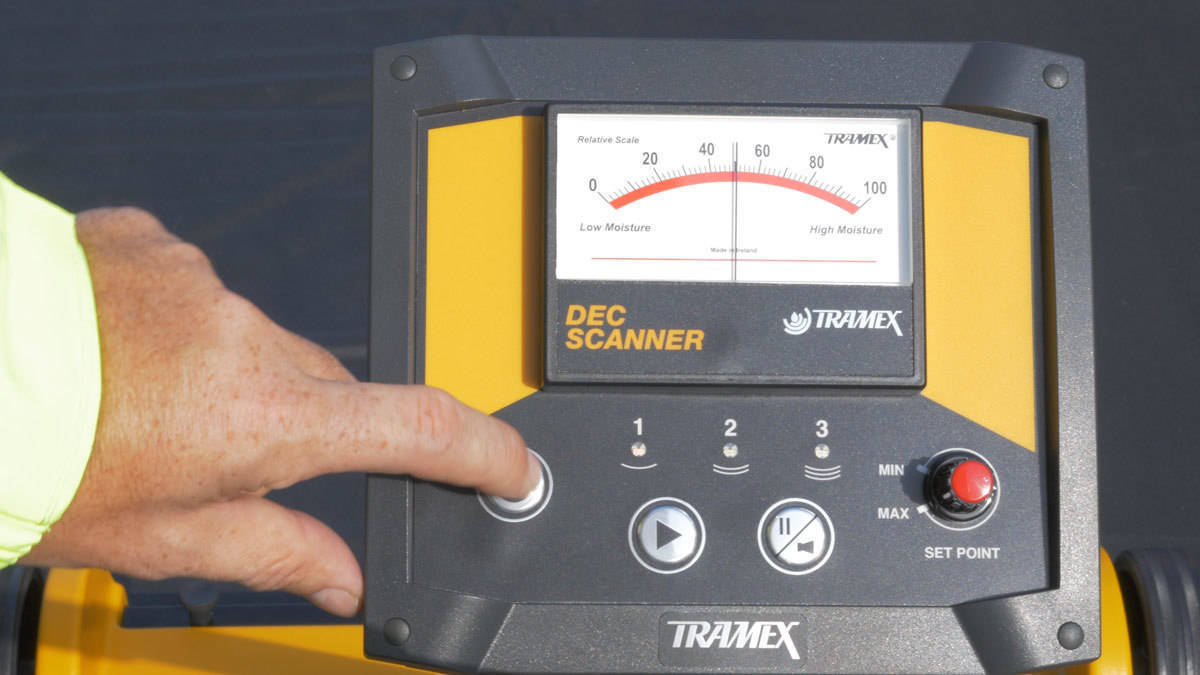
The recover-versus-replace decision on a Tucson commercial roof is not a visual call. A silicone coating over wet insulation is a capital mistake - the coating passes its warranty inspection but the saturated insulation below it continues to degrade the deck through Tucson's heat cycle. Core sampling tells you what the membrane surface cannot. We pull cores to find out before we write the scope.
The single most expensive mistake in commercial roofing is recovering a roof with wet insulation. In Tucson, the risk of this mistake is higher than in moderate climates because the mechanism that saturates the insulation - monsoon rainfall infiltrating through UV-degraded seams - is often invisible at the membrane surface. The seam may appear intact in a visual inspection while moisture has been migrating through micro-failures for one or two monsoon seasons, spreading through the insulation stack by capillary action and lateral migration under the thermal cycle that follows. By the time the membrane surface shows evidence of the saturation, the wet area may extend well beyond the apparent defect zone.
The consequence of coating over that wet insulation is significant. The silicone coating is applied per specification and passes the manufacturer's inspection. The moisture is now trapped under two membrane layers and a coating. Tucson's summer heat cycle - rooftop surface temperatures above 175°F on dark and intermediate-color membranes - does not dry the insulation. It drives the moisture deeper and accelerates deck corrosion beneath it. Five to seven years after the coating project, the building needs a full tear-off of the coating, the original membrane, and the damaged insulation, with possible deck repair - a project that costs two to three times what full replacement would have cost at the coating decision point.
Core sampling is the tool that makes the recover-versus-replace decision honest. We pull cores at drain pans, parapet corners, mid-field locations, and any area flagged by interior ceiling staining or membrane probe-test failure. In Tucson, the monsoon saturation pattern is predictable by location: drain areas where water has ponded during convective events, parapet corners where back-drainage has stressed flashing seams, and penetration clusters where equipment additions have created non-original penetration details. We sample at those locations first, then at the grid points that establish the wet-area percentage.
Core Sampling Protocol
We pull cores with a 4-inch diameter core cutter at representative locations identified before the site visit by reviewing the existing inspection record, drain layout, and the building's monsoon-season complaint history if available. Each core pulls through the membrane and the full insulation stack to the deck surface. We record the number of plies, insulation type and thickness, condition of each layer, and whether the insulation is wet, damp, or dry by direct physical assessment.
For Tucson buildings with multiple membrane layers - common in buildings that have had one or more recovers installed over the original roof - we document each layer and its condition separately. A building with a recover installed over a saturated original roof may have dry insulation in the recover layer and wet insulation in the original layer below it, which tells a different capital story than uniform saturation through the full stack.
After pulling, each core location is repaired with membrane-matching material and resealed on the same site visit. Core locations are logged on the zone diagram so the owner has a permanent record of where each core was pulled and what it found. This matters for Tucson buildings where we pull cores at the same locations across multiple survey cycles to track whether saturation is advancing, holding, or - in rare cases where source intrusion has been stopped and conditions allow - receding.
Moisture Distribution Mapping and the Tucson Decision Threshold
Core results are plotted on the zone diagram to produce a moisture distribution map. Wet cores, damp cores, and dry cores are marked distinctly. The spatial pattern tells the capital story: clustered moisture at drain pans and parapet corners is the typical Tucson monsoon-infiltration pattern - discrete source locations with lateral migration. Dispersed moisture across mid-field locations suggests either a seam failure affecting a broad area or multi-year accumulated diffuse infiltration through a uniformly degraded membrane.
The 25 percent threshold is the conventional recover-versus-replace decision point. If more than 25 percent of the roof area has wet or significantly damp insulation, recovering is not a supportable scope - the recover manufacturer will not warranty a system installed over wet insulation, and the trapped moisture will advance deck deterioration under Tucson's sustained heat load. Below 25 percent, a selective-tear-off recover - where wet zones are torn off to the deck, the deck is inspected and repaired, and only those areas receive new insulation before the recover membrane goes on - is a legitimate capital option that typically costs 40 to 60 percent of full replacement in the Tucson market.
We present the decision analysis in writing with the moisture distribution map and core data as supporting documentation. The recommendation is coating-viable, selective-tear-off recover, full replacement, or - in cases where wet-area distribution makes the scope complex - a staged approach. For Tucson buildings approaching the coating decision, the core data is the document that either enables the coating option or closes it.
Sample Density and Statistical Confidence
A five-core sample on a 75,000 square foot Tucson building tells you almost nothing - the typical monsoon saturation pattern creates wet zones at predictable locations that a sparse grid easily misses between cores. We size core density to produce a statistically meaningful result for the decision at hand.
For coating candidacy decisions, we want enough cores to say with confidence that wet-area percentage is above or below the 25 percent threshold - not a best-guess estimate. For Tucson buildings where the monsoon infiltration pattern has concentrated at predictable locations, we front-load cores at drain pans and parapet corners, then confirm with mid-field cores at a density that would not miss a wet zone larger than 5,000 square feet. For acquisition due diligence, we want enough coverage to estimate the magnitude of the moisture liability across the full roof area. We document the sample density and the confidence level in the moisture survey report.
Frequently asked questions
Does core sampling damage the roof?
Minimally and temporarily. Each core leaves a 4-inch diameter opening that we repair on the same site visit with membrane-matching material - TPO patch on a TPO roof, modified bitumen patch on modified bitumen. The repair is watertight before we leave. In Tucson, where the monsoon season can produce a storm within hours of a site visit in July or August, we do not leave core openings unsealed.
When should we pull cores versus using infrared scanning?
Infrared scanning identifies probable moisture zones by detecting heat retention in wet insulation after solar loading. Core sampling confirms what infrared identifies. We use both tools together on large Tucson roofs - IR narrows the core sampling locations, cores confirm the findings. On smaller buildings or buildings where prior inspections have identified specific suspect zones, cores at targeted density often produce equivalent confidence at lower total cost than IR plus cores. The choice depends on the building's size, the distribution of suspect zones, and the season.
Can moisture survey results support a monsoon-season insurance claim?
Core sampling documents physical condition at the time of the survey. If an owner needs to demonstrate that insulation saturation resulted from storm-event infiltration rather than pre-existing conditions - or if an insurance adjuster is disputing the extent of storm-related insulation damage - core sampling produces the physical evidence the claim needs. Rapid sampling after a monsoon event, before additional storms complicate the evidence, produces the most useful claim documentation.
How long does a moisture survey take?
For a 50,000 square foot building with 15 to 20 cores, site work takes four to six hours including core pulling, repair, and documentation. Larger buildings or buildings where we are running a grid survey at higher density take longer. The written moisture survey report is delivered three to five business days after the site visit. For urgent coating or acquisition decisions, contact us at 520-523-6122 to discuss accelerated turnaround.
Get moisture survey data for your Tucson roof's recover-or-replace decision.
Core sampling and moisture distribution mapping tell you what the membrane surface cannot - and in Tucson, that data is the difference between a coating project that works and one that traps moisture under the Sonoran Desert heat cycle. Call 520-523-6122 or use the form.
Ready to talk through a roof?
Tell us about the building and the roof problem. We'll document it and put a plan in writing - with an honest repair-vs-replace recommendation and no upsell pressure.
Documented, repair-first commercial & industrial roofing across Tucson and Pima County. Flat and low-slope systems for occupied buildings, planned around your operation.
Services
© 2026 Commercial Roofing Contractors Tucson. All Rights Reserved. Privacy Policy · Terms of UseSite Map