
Commercial Re-Roofing in Tucson, AZ
Commercial Re-Roofing for commercial buildings across Tucson.
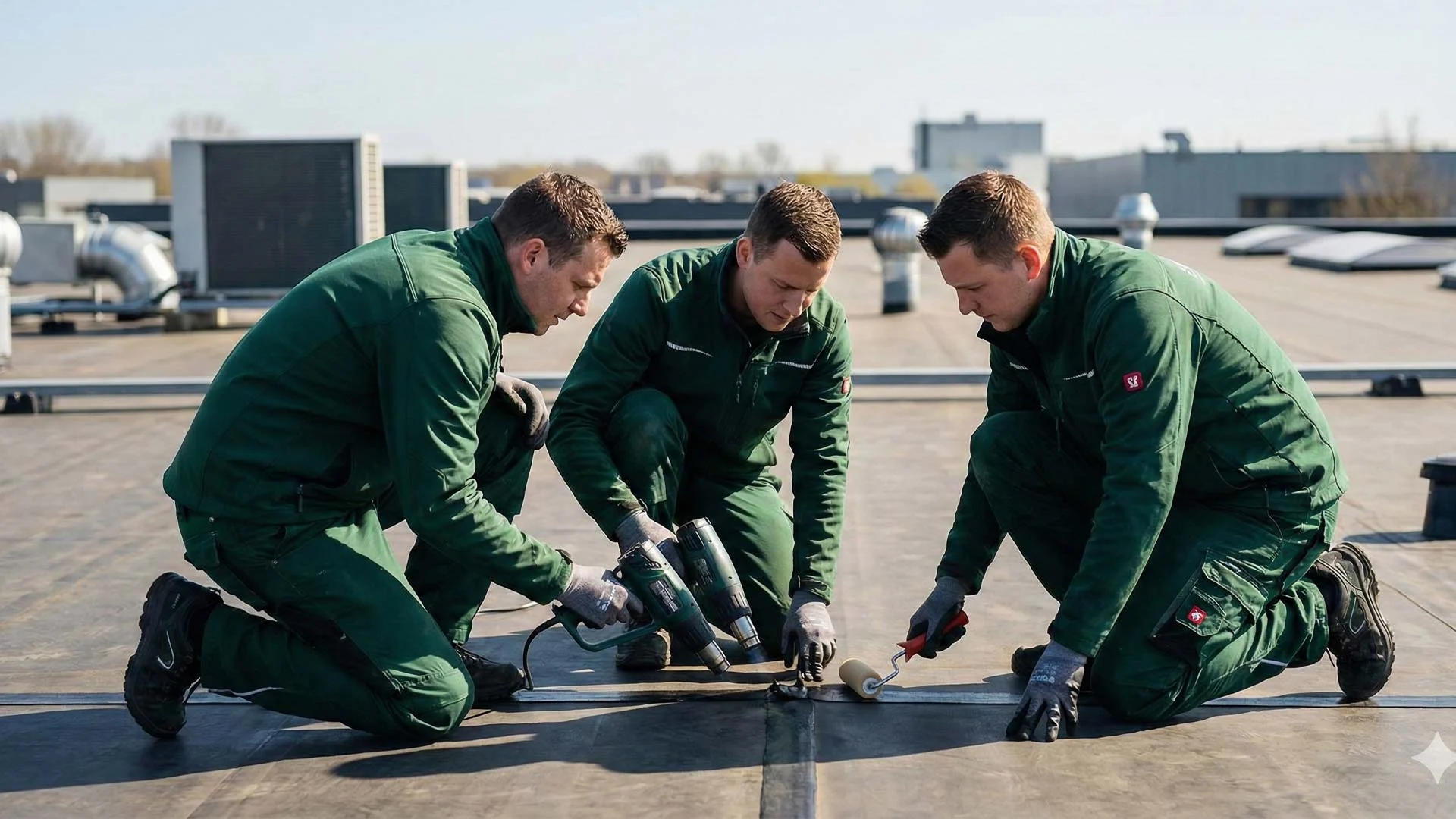
Most commercial roof replacements in the Tucson market get triggered reactively - a monsoon event saturates insulation that has been cooking for years, someone calls around, and the project gets scoped on urgency rather than condition data. The result is a new membrane over wet insulation, which voids the manufacturer warranty in the first season and accelerates deck corrosion under the Sonoran heat cycle. We do not work that way.
Every replacement scope we write begins with a documented roof walk and moisture-core pulls at drain pans, parapet corners, mid-field locations, and any area a facility manager has flagged from interior ceiling staining. The Tucson climate creates a specific insulation-saturation pattern: UV degradation softens membrane seams, early-season monsoon events push water under the membrane before it is detected, and the heat cycle that follows drives absorbed moisture deeper into the insulation stack rather than evaporating it. We pull cores to find it before we write the scope.
The deliverable at closeout is the warranty document, a roof zone diagram with all closeout photos keyed to location, the maintenance contract that keeps the warranty active, and a written record of the system specification - membrane type, insulation R-value, attachment method, fastener density - that the next facility manager or building owner can build a capital plan against.
Why the Sonoran Desert Changes Replacement Scope
Tucson sits at approximately 2,400 feet elevation in ASHRAE Climate Zone 2B - hot-dry. Summer ambient temperatures exceed 105°F on most July and August days. Rooftop surface temperatures on dark membranes have been recorded above 175°F in this market. Standard-density polyiso insulation loses R-value at elevated temperatures; the effective R-value of a 4-inch standard-density polyiso board at 175°F surface temp is materially lower than its rated value at 75°F. Every replacement scope we write specifies either high-density polyiso or a polyiso-plus-cover-board stack that accounts for this thermal drift.
Reflectivity is not optional in Tucson commercial roofing - it is the primary energy-compliance and membrane-longevity driver. White or light-gray TPO and PVC membranes reduce rooftop surface temperatures by 50°F to 70°F compared to dark surfaces in this climate. Arizona's energy code (IECC 2018 with Arizona amendments) mandates minimum solar reflectance for new commercial roofs in Climate Zone 2. We specify membrane color and reflectivity in every project scope and document the compliance values in the closeout file for the building owner's energy records.
Silicone restoration coatings are widely used in the Tucson market as a recover strategy on roofs with sound substrate and light saturation. We assess every aging membrane for coating candidacy before recommending tear-off - if the substrate is dry and the membrane is intact, a silicone coating system can extend service life 10 to 15 years at roughly one-third the cost of replacement. That recommendation goes to you in writing with the moisture-core map and the coating specification attached.
Monsoon Season and Dry-In Protocol
Tucson's monsoon season runs July through September. The North American Monsoon delivers intense convective storms that can produce over an inch of rainfall in under an hour, with little advance warning. The National Weather Service Tucson office issues Flash Flood Watches that activate within 30 to 60 minutes of storm initiation. A commercial building with an open roof section at the start of a Tucson afternoon in August is at real risk of significant interior water damage.
Our monsoon dry-in protocol is non-negotiable from July 1 through September 30: no section is left open overnight, and every section torn off in the morning is dried in before crew departure regardless of the afternoon forecast. We maintain a standing weather-monitoring protocol during monsoon season and stage tear-off in sections that can be dried in within the same work window. Production timelines during monsoon season reflect this discipline - owners receive a written sequencing plan before contract execution that documents the daily section sizes and dry-in method.
Dust storms - haboobs - accompany the monsoon season and can reduce visibility to near zero with 60-mph wall winds. We monitor the National Weather Service Tucson Spotter Network and pull crews from exposed locations when a haboob warning is issued. This is standard practice in Tucson commercial construction and is factored into our production schedules.
Pima County Permits and Project Sequencing
Commercial roofing replacements in the City of Tucson and unincorporated Pima County require building permits. The City of Tucson Development Services Center processes commercial roof permits with typical turnaround of 7 to 10 business days for straightforward projects. IECC energy compliance documentation - R-value calculation, insulation specification, reflectivity values - is reviewed at submittal rather than at inspection, which requires precise documentation upfront. We prepare the permit package and manage the submittal process as part of every project.
For commercial buildings on University of Arizona campus or in UA Tech Park, we coordinate directly with UA's Facilities Management department. Banner Health campuses - Banner University Medical Center Tucson on Campbell Avenue, Banner UMC South, and Oro Valley Hospital - require infection-control coordination and off-hours scheduling for any occupied floor adjacency. We have a pre-construction meeting protocol for healthcare facilities that covers hot-work permits, odor-generating operations, and tenant-notification requirements specific to hospital operations.
Closeout documentation includes the manufacturer warranty document, roof zone diagram with all inspection and closeout photos keyed to location, maintenance contract, and energy-compliance summary with reflectivity and R-value documentation. The facility manager receives a physical and digital copy at the final walk.
Frequently asked questions
How does Tucson's monsoon season affect a commercial roof replacement timeline?
Monsoon season (July through September) extends project timelines because we size daily tear-off sections to what we can dry in the same day. We do not leave open sections overnight during monsoon. For a 50,000 sq ft building, this typically adds one to two weeks compared to a non-monsoon-season schedule. Owners receive a written sequencing plan before contract execution that documents the daily section size and dry-in protocol.
What membrane type is standard for Tucson commercial roofs?
TPO and PVC are the predominant single-ply membranes in the Tucson market because their white or light-gray surfaces reflect solar radiation, reducing rooftop surface temperatures by 50 to 70 degrees compared to dark membranes. This matters for both energy compliance (Arizona IECC 2018) and membrane longevity. Black EPDM is used selectively on industrial buildings where heat absorption is not a concern. Modified bitumen and silicone coating systems are used on appropriate substrates. We do not have a preferred-manufacturer relationship - the right system depends on your building, your budget, and your capital horizon.
Will you assess whether a coating is an option before recommending full replacement?
Yes. Every aging Tucson commercial roof gets moisture cores pulled before we write a scope. If the core data shows the substrate is dry and the membrane is intact, a silicone coating system is often the right capital call - typically one-third the cost of tear-off and replacement, with 10 to 15 years of additional service life when properly specified and applied. If the core data shows saturation, coating over wet insulation voids the new coating warranty and accelerates deterioration. We give you the core data and the scope recommendation in writing so you can make the decision on facts.
Are you licensed to work in Arizona?
Arizona requires commercial roofing contractors to hold a Registrar of Contractors license. We carry active ROC licensure along with general liability, workers' compensation, and umbrella coverage at limits appropriate for every commercial project we take on. Certificates of insurance are provided on request. We pull City of Tucson or Pima County building permits for all replacement work.
Get a documented replacement scope for your Tucson building.
Our project managers will walk the roof, pull moisture cores where the coating-vs-replacement decision depends on saturation data, and produce a written scope that includes insulation specification, reflectivity compliance, and monsoon-season sequencing.
Commercial Re-Roofing in Tucson, AZ begins with a structural load check. Before any tear-off is priced, the building's roof deck capacity must be verified against the weight of the proposed new assembly - new insulation, cover board, membrane, ballast if applicable, and any required drainage improvements. For commercial re-roofing in Tucson, the code also controls how many membrane layers can remain on the deck: most jurisdictions follow the two-layer maximum specified in the International Building Code, which means full tear-off may be required even when the top membrane looks serviceable.
Insulation is the largest cost driver in commercial re-roofing after tear-off labor. Energy codes in AZ - whether Title 24, ASHRAE 90.1, or a local supplement - set minimum R-value targets for roof assemblies above conditioned space. A commercial re-roofing project that does not meet the current energy code may require additional insulation thickness to obtain a permit, which changes the scope, the deck load, and the tapered insulation design around drains. Commercial Roofing works through those calculations before presenting a commercial re-roofing budget so the number in the estimate reflects the actual permitted scope.
Permit documentation for commercial re-roofing in Tucson typically requires product data sheets, a roof plan or sketch showing drainage and slopes, a disposal plan for tear-off material, and sometimes a structural engineer review letter when the new assembly is heavier than the existing one. We assemble that documentation package and coordinate with the building department on the inspection schedule so the commercial re-roofing project closes without a certificate-of-occupancy hold.
Warranty implications matter for commercial re-roofing decisions. A roof manufacturer will not extend a new system warranty over a tear-off site with an unaddressed deck repair or compromised substrate. We document deck conditions found during tear-off, provide photographic evidence of substrate quality, and give ownership the information needed to decide whether manufacturer warranty coverage is worth the additional substrate repair cost. Call or email to schedule a commercial re-roofing assessment in Tucson.
Questions Owners Ask
Widespread wet insulation, a second membrane layer already present, deck deterioration, repeated failed repairs, and energy code compliance gaps on a permit-requiring scope all push toward full re-roofing.
ASHRAE 90.1 or state-specific energy codes set minimum insulation R-values that may require added insulation thickness beyond what the existing assembly provides, increasing both cost and structural load.
Product data sheets, a roof plan or sketch, a disposal plan, sometimes a structural engineer review, and contractor licensing documentation. We assemble the permit package and coordinate the inspection schedule.
Membrane layer count, deck condition found during inspection, moisture scan results, and the code-required maximum layer count all determine whether full tear-off or partial removal is required.
Ready to talk through a roof?
Tell us about the building and the roof problem. We'll document it and put a plan in writing - with an honest repair-vs-replace recommendation and no upsell pressure.
Documented, repair-first commercial & industrial roofing across Tucson and Pima County. Flat and low-slope systems for occupied buildings, planned around your operation.
Services
© 2026 Commercial Roofing Contractors Tucson. All Rights Reserved. Privacy Policy · Terms of UseSite Map