
Silicone Roof Coating in Tucson, AZ
Fluid-applied silicone restoration for Tucson commercial roofs - the dominant capital strategy for qualifying substrates in the Sonoran Desert. 10, 15, and 20-year warranty paths with honest substrate assessment first.
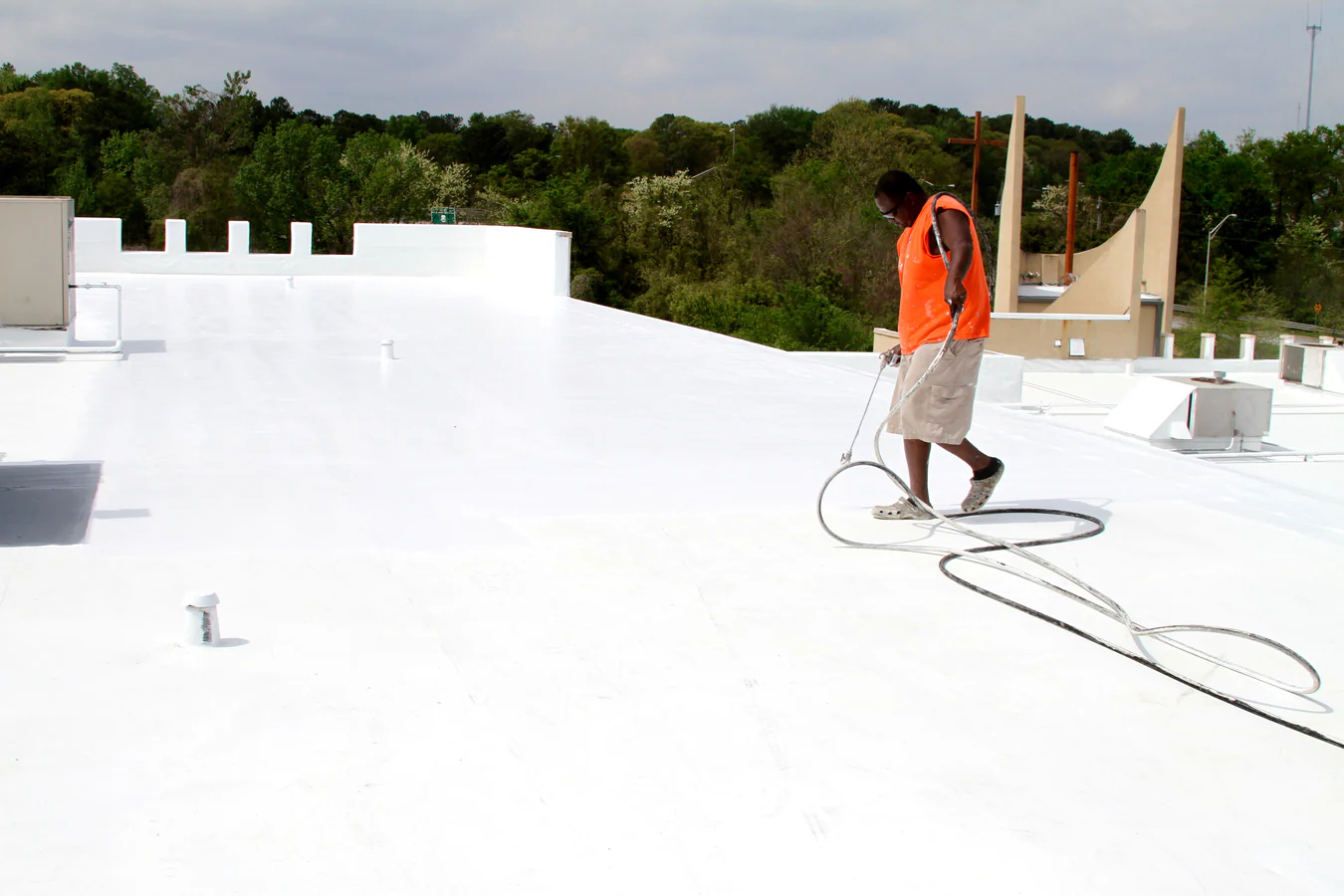
Silicone fluid-applied restoration is the first-choice capital strategy for qualifying Tucson commercial roofs - not because it is the lowest-cost option on paper, but because it is frequently the most cost-effective decision when you account for Tucson's reflectivity requirements, the cost of full tear-off and disposal, and the manufacturer-warranted service life the coating delivers on a dry substrate. We assess every aging Tucson commercial roof for coating candidacy before recommending tear-off.
Silicone fluid-applied roofing restores an existing qualifying membrane by encapsulating it under a seamless, UV-stable silicone layer that provides a new manufacturer-warranted service life at roughly 40-50% of the installed cost of full tear-off replacement. In the Tucson market, the silicone coating category has grown substantially over the past decade as the single-ply and modified bitumen roofs installed during the 1990s through 2010s Tucson commercial buildout now qualify for restoration - the timing matches the maturation of the commercial inventory along Oracle Road, Speedway, Broadway, and the Foothills corridors.
The Sonoran Desert creates specific conditions that make silicone restoration particularly well-suited to Tucson commercial work. Silicone is UV-stable - it does not degrade at Tucson's UV Index 11-plus exposure the way acrylic and urethane coatings do. It is also ponding-water tolerant, which matters during monsoon events that leave standing water on low-drainage roofs for extended periods. And silicone restores solar reflectance on oxidized membranes that have darkened over years of sun exposure, bringing the roof back into IECC Climate Zone 2B energy-compliance territory without a full system replacement.
We apply silicone coating systems from established manufacturers whose products carry documented performance data at high-UV desert exposures. We are not a coatings-only contractor pushing silicone as the answer to every aging Tucson roof. A coating over wet insulation fails its warranty inspection and traps moisture under the Sonoran heat cycle, accelerating deck corrosion rather than preventing it. Our first step on every coating inquiry is an honest moisture-core assessment.
When Silicone Coating Is the Right Scope in Tucson
A Tucson commercial roof qualifies for silicone restoration when three physical conditions are met: the insulation is dry (confirmed by moisture core sampling at representative locations across all roof zones), the existing membrane is structurally sound and adhered with no open seams, no delaminated sections, and no saturated field areas, and the deck shows no compromise at core-cut locations. Buildings that
The most common qualifying substrates on Tucson commercial buildings are: mechanically attached or adhered TPO membranes 10-20 years old that are still in sound membrane condition; modified bitumen cap sheet in fair-to-good surface condition; and spray polyurethane foam (SPF) systems that have reached their scheduled recoat interval - Tucson's SPF inventory from the 1990s through 2000s commonly coats over with silicone at the 10-15 year maintenance interval. BUR surfaces can qualify with appropriate primer preparation, but substrate variability is higher and our assessment threshold for BUR coating is more conservative than for single-ply.
Tucson timing: a significant share of the Oracle Road, East Broadway, and midtown Speedway corridor office and industrial buildings installed first-generation TPO or modified bitumen systems between 1995-2012. Buildings in that vintage cohort that maintained annual inspection programs and have dry insulation are frequently in the coating qualification window. One inspection visit tells us where a specific roof lands - we do not speculate without data.
Substrate Prep in the Sonoran Desert Environment
Silicone coating adhesion depends entirely on substrate preparation. We do not shortcut prep to hit a price point because the manufacturer's warranty inspection will find it. Standard prep sequence on Tucson commercial roofs: power washing at 3,500-4,000 PSI to remove UV-oxidized chalk, biological growth (surprisingly common on shaded north parapets in Tucson), and mineral surface debris from BUR or modified bitumen surfaces; full inspection and documentation of open seams, failed flashings, or wet areas requiring repair before coating; targeted repair of all deficiencies; and manufacturer-specified primer application on substrates that require it.
Tucson's heat creates substrate prep timing constraints that do not exist in more moderate markets. Summer ambient temperatures mean a power-washed membrane surface can reach coating-application temperatures within 30 minutes of washing - we schedule coating application to begin the same morning the prep is completed, not the following day. The Sonoran Desert's generally low humidity is actually advantageous for coating adhesion compared to humid markets, but silicone application during monsoon season requires careful ambient monitoring: relative humidity above 80% and rising can cause coating adhesion problems, and Tucson's monsoon afternoons can reach those conditions with little advance notice.
Application mil thickness verification is non-negotiable. We use a wet-mil gauge after every 1,000 square feet of application and at every flashing detail to confirm thickness before the silicone cures - silicone cannot be added after cure without additional priming. Every application session is logged with ambient temperature, relative humidity, substrate temperature, and wet-mil readings at the documentation locations.
Warranty Paths - 10, 15, and 20 Years
Ten-year silicone warranty systems apply a minimum 20-wet-mil dry-film thickness in two passes. This is the entry-level restoration path appropriate for Tucson buildings where the owner's capital horizon is 10-15 years and the goal is deferring replacement cost while maintaining a warranted watertight system. In the Sonoran Desert environment, 10-year systems require annual inspection and drain maintenance to stay within their performance envelope - skipped inspections on Tucson roofs cost service life.
Fifteen-year systems apply 25-30 dry-mil in two or three passes with reinforcing fabric embedded at flashings and seams. The fabric reinforcement at parapet flashings is particularly important in Tucson: parapets receive the highest direct UV dose of any surface on a flat roof, and fabric-reinforced flashing details hold up against the thermal cycling and UV degradation that bare-coating parapet terminations face. The 15-year path is the most common recommendation for Tucson commercial buildings with substantial parapet lengths or high penetration counts.
Twenty-year systems apply 30-35 dry-mil in three passes with full fabric reinforcement at all seams and flashings. This is the maximum warranted service life available on fluid-applied silicone and produces the lowest lifecycle cost per year for Tucson buildings with longer capital horizons. Several major silicone coating manufacturers require a pre-application inspection by their field representative before issuing the 20-year warranty - we schedule and accompany that inspection as part of the project scope.
Frequently asked questions
How do I know if my Tucson commercial roof qualifies for silicone coating?
We walk the roof, pull 4-6 moisture cores at drain pans, parapet corners, mid-field zones, and any areas flagged from interior ceiling staining, and inspect the membrane for open seams and delamination. On a 50,000 sq ft Tucson commercial building the inspection runs 2-3 hours. We produce a written assessment: qualifies (with substrate conditions and core data documented) or does not qualify (with the replacement recommendation). No charge for inspections on buildings where we have a reasonable shot at earning the project.
Does silicone hold up to Tucson's UV exposure?
Yes - silicone is the coating chemistry that holds up best under sustained high-UV exposure, which is one of the primary reasons it dominates the Tucson commercial restoration market over acrylic and urethane alternatives. Silicone's UV resistance is a polymer-chemistry property, not a surface treatment that wears off. A properly applied and maintained silicone system at the warranted mil thickness retains its reflectance and watertight performance throughout the warranty term in Sonoran Desert conditions.
Can a silicone coating be recoated when the warranty expires?
Yes. One of silicone's long-term capital advantages is that a properly applied system can be recoated at the end of its warranty term - typically a 10-15 mil recoat pass over the existing silicone - renewing the warranty at a fraction of the original application cost. In Tucson, where full replacement involves tear-off, landfill disposal, and new insulation in a market with high summer labor costs, the recoat path on a well-maintained silicone system is a compelling long-term capital strategy.
Wondering if your Tucson commercial roof qualifies for silicone restoration?
We will walk the roof, pull moisture cores, and produce a written substrate assessment - with coating warranty paths and installed cost estimates, or an honest replacement recommendation if coating is not the right scope.
Ready to talk through a roof?
Tell us about the building and the roof problem. We'll document it and put a plan in writing - with an honest repair-vs-replace recommendation and no upsell pressure.
Documented, repair-first commercial & industrial roofing across Tucson and Pima County. Flat and low-slope systems for occupied buildings, planned around your operation.
Services
© 2026 Commercial Roofing Contractors Tucson. All Rights Reserved. Privacy Policy · Terms of UseSite Map