
Modified Bitumen Roofing in Tucson, AZ
Modified bitumen roofing installation and recover for Tucson commercial buildings - torch-down SBS and self-adhered cold-applied systems, with honest guidance on where mod-bit remains the right call in the Sonoran Desert market.
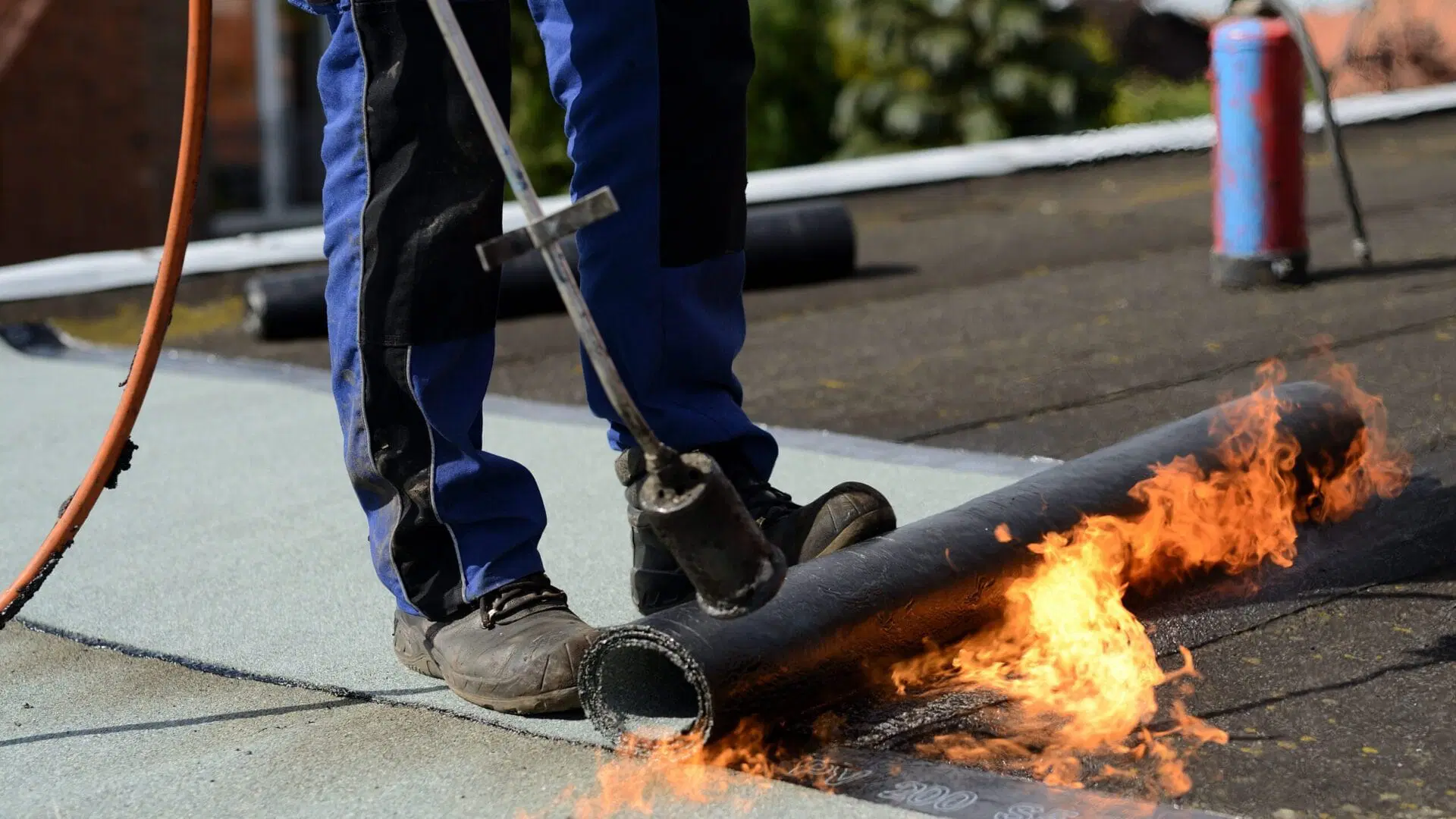
Torch-down SBS and cold-applied self-adhered modified bitumen on qualifying Tucson commercial recover and replacement projects - with a straight account of where mod-bit is the right call in 2024 and where white single-ply has become the more durable Sonoran Desert specification.
Modified bitumen is not the right specification for most new commercial roofing projects in Tucson - and we say that directly, because the Sonoran Desert's energy code and UV environment make reflective white membranes the dominant performance standard for this market. Arizona's IECC 2018 energy code requires solar reflectance compliance for new commercial roof installations in Climate Zone 2B. Standard granulated SBS mod-bit cap sheet in gray or black runs Solar Reflectance Index values of 5 to 25 - well below the energy code threshold without white-granule surface specification or a reflective coating applied after installation. This matters for building owners: non-compliant installations create permit closure problems and are a liability in property transactions.
Where modified bitumen remains the right specification in Tucson is a specific and defined set of scenarios. Recover over existing built-up roofing (BUR) on older commercial buildings in the Downtown and Midtown corridor, where removing original gravel-surface BUR is cost-prohibitive and the existing system is still mechanically sound. Complex small roofs with dense penetration clusters where mod-bit's multi-ply system handles penetration detailing more efficiently than single-ply. Cold-storage and temperature-differential applications where the multi-ply vapor management tolerates unusual pressure conditions. Self-adhered cold-applied systems on occupied medical or institutional buildings where hot-work permitting is burdensome.
We install mod-bit when it is the right specification and say plainly when it is not. We do not have a commercial interest in steering owners toward mod-bit over white single-ply or vice versa - the recommendation follows the building's requirements.
Where Modified Bitumen Remains the Right Call in Tucson
Recover over existing BUR on Tucson's older commercial inventory: Tucson's Downtown and Midtown commercial building stock includes 1960s through 1980s construction with original gravel-surface built-up roofing. Full tear-off of an original four- or five-ply BUR system on a 10,000 to 30,000 square foot building can cost as much as the replacement membrane installation. Where core pulls confirm the existing BUR is dry and mechanically sound, a modified bitumen recover - applying a new white-granule SBS cap sheet over a leveling base ply - is a cost-effective life extension that preserves the functional base system while adding a warranted new surface. White-granule cap sheet achieves energy code compliance.
Small and complex roofs with multiple penetrations: Tucson's midtown medical office and professional building inventory includes buildings with penetration-dense roofs - condensate lines, multiple HVAC curbs, exhaust flues, conduit clusters - that are detailed more reliably in modified bitumen than in single-ply where every penetration requires a custom-welded or adhesive-set flashing assembly. On roofs under 5,000 square feet with 20 or more penetrations, mod-bit detailing is often faster and produces more durable results than single-ply.
Self-adhered systems for Tucson medical and occupied-building installation: Cold-applied self-adhered modified bitumen eliminates open-flame torch operations entirely, removing the hot-work permitting burden that Banner Health, TMC HealthCare, and University of Arizona Facilities Management impose on occupied-building roof projects. Installation is slower per square than torch-applied, but the hot-work elimination simplifies project scheduling at facilities where the daily permit approval process is operationally significant.
Where Single-Ply Has Become the Better Tucson Specification
Energy code compliance: Arizona's IECC 2018 energy code in Climate Zone 2B requires minimum solar reflectance on new commercial roof installations. White TPO and white PVC achieve SRI values of 78 to 104 without any additional specification. Standard SBS mod-bit in gray or black does not For any new Tucson commercial installation where energy code compliance is the default requirement, white single-ply is the simpler and more reliable specification path.
Large warehouse and industrial footprints: On roofs above 15,000 to 20,000 square feet, mechanically attached white TPO installs faster than torch-down mod-bit, carries equivalent 20-year NDL warranty terms, and provides energy-code-compliant reflectivity without supplemental specification steps. The labor efficiency differential on large industrial footprints - the Irvington Road and Alvernon Way distribution and defense-support corridors, for instance - makes white single-ply the more economic capital decision.
Long-term warranty requirements: The maximum standard manufacturer warranty on modified bitumen from major manufacturers is 20 years, and many programs cap at 15. TPO and PVC carry 20-year and 25-year NDL programs. For Tucson building owners making a capital decision with a 20-to-25-year horizon, single-ply wins on warranty term.
Torch-Down Safety Protocol in Tucson
Torch-applied SBS requires City of Tucson or Pima County hot-work permits. City of Tucson Development Services processes hot-work permits as part of the commercial building permit - we prepare and submit the permit package as part of every torch-applied project scope. Pima County unincorporated parcels follow the county development services process. We maintain a fire watch standby for the duration of all torch operations and for the code-required 30-minute post-torch cool-down period on every project day.
Haboob risk during monsoon season creates additional site-safety considerations for torch operations. We monitor National Weather Service Tucson dust storm advisories and pull torch operations when a haboob wall is within 30 minutes of the project site - an approaching dust storm combined with open-flame operations on a commercial roof creates a fire-propagation risk that we do not take. Torch schedules during July through September reflect this constraint.
Frequently asked questions
Can you recover an existing mod-bit roof in Tucson with new modified bitumen rather than tearing off?
Yes, when core pulls confirm dry insulation and the existing membrane is adhered well enough to provide a stable substrate for the new cap sheet. One-ply white-granule SBS cap sheet over an existing granulated cap sheet is a standard project type on Tucson's older commercial inventory. White-granule specification is recommended for energy code compliance in Climate Zone 2B - we specify the reflectance values in the submittal package and include them in the permit closeout documentation.
Is torch-down roofing safe during Tucson's monsoon season?
Yes, with the appropriate weather monitoring protocol. We watch National Weather Service Tucson advisories for haboob warnings and afternoon convective storm development. When a dust storm is approaching, we suspend torch operations and secure any open sections before the wall arrives. We do not leave open sections unattended when afternoon convective storm development is active over the Santa Catalinas or Rincon Mountains. Our torch scheduling during July through September accounts for the compressed safe-work window and presents a realistic production timeline to the building owner before contract execution.
What warranty can I get on a new modified bitumen roof in Tucson?
15-year NDL warranties are the most common for two-ply SBS systems from manufacturers including GAF, Johns Manville, and Soprema. 20-year NDL is available on premium SBS cap sheet specifications from Johns Manville and Soprema on qualifying system configurations with documented installation by credentialed applicators. Warranty programs require documented annual or semi-annual maintenance - same documentation requirements as TPO and EPDM NDL programs.
Modified bitumen recover or replacement on a Tucson commercial building?
We will walk the roof, pull cores, and give you a straight recommendation - mod-bit recover, mod-bit replacement, or white single-ply - based on your building's substrate condition, energy code requirements, and capital horizon.
Ready to talk through a roof?
Tell us about the building and the roof problem. We'll document it and put a plan in writing - with an honest repair-vs-replace recommendation and no upsell pressure.
Documented, repair-first commercial & industrial roofing across Tucson and Pima County. Flat and low-slope systems for occupied buildings, planned around your operation.
Services
© 2026 Commercial Roofing Contractors Tucson. All Rights Reserved. Privacy Policy · Terms of UseSite Map